Pythagoras
Pythagoras and numerology
The most popular numerology system carries Pythagoras' name, and tradition calls him its founder. The short answer is that the name is real branding and the founder story is mostly myth: the man wrote nothing, the letter chart is modern, and the practice of reading your character from a name or birth date is about a century old. Here is what the Pythagoreans actually did, and where the seam between the two really runs.
By NumelunaPublished
What people mean by Pythagorean numerology
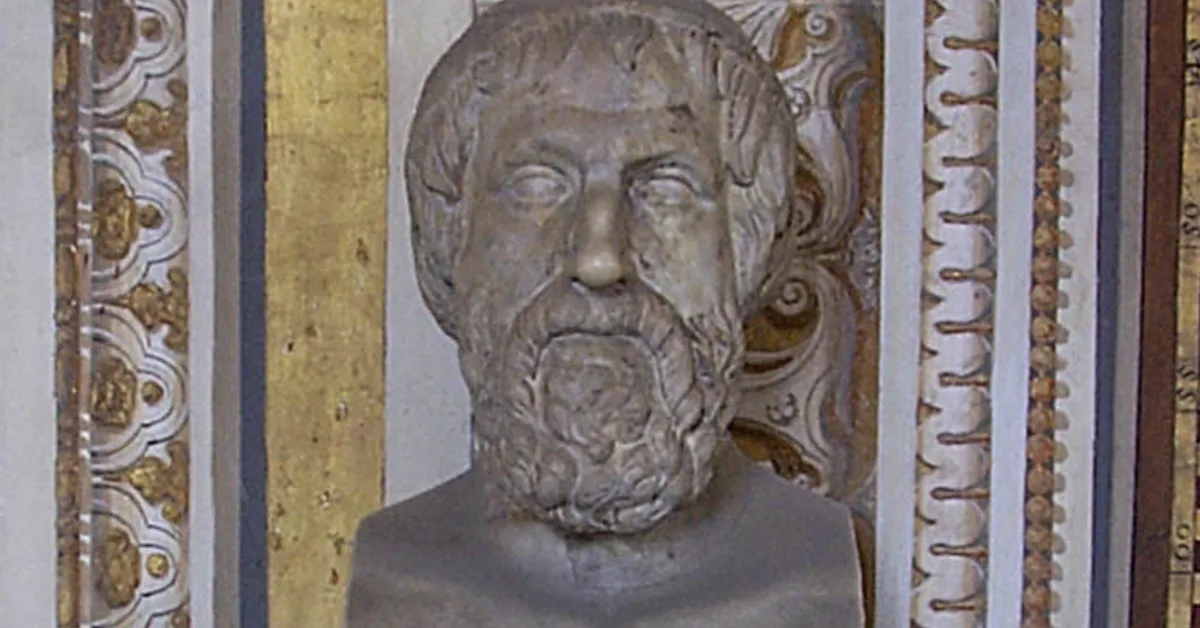
When people search for Pythagorean numerology they usually mean one of two things, and it helps to keep them apart. The first is a method: the dominant modern Western way of turning a name into numbers, using a nine-column chart that carries Pythagoras’ name. The second is a claim: that Pythagoras, the sixth-century-BCE Greek philosopher, invented numerology in the first place.
The method is real and worth learning. The claim is mostly myth, and the honest version of the story is more interesting than the one most pages tell. The two answers turn out to be separated by roughly two thousand years, and almost nobody says so.
The Pythagorean chart, worked by hand
The system’s whole method is one chart. Lay the alphabet out in nine columns and each letter takes the number above it:
To read a name you convert each letter, add them, and reduce the total to a single digit by adding its digits again. It is the same reduction used on a birth date. Fittingly, the clearest example to work is the name itself:
PYTHAGORAS
P7 Y7 T2 H8 A1 G7 O6 R9 A1 S1
Sum7 + 7 + 2 + 8 + 1 + 7 + 6 + 9 + 1 + 1 = 49
Reduce49 → 4 + 9 = 13 → 1 + 3 = 4
From this one chart the name-based core numbers all follow: your Expression number counts every letter, your Soul Urge the vowels, your Personality the consonants. The other two of the five come from your birth date instead of your name: your Life Path and your Birthday number. Any of them can land on 11, 22, or 33 on the way down, and the system keeps those master numbers whole rather than reducing them the final step. The arithmetic is honest and checkable; that part of “Pythagorean numerology” does exactly what it says.
This is the Pythagorean chart specifically. A rival, the Chaldean chart, assigns letters differently (1–8, never 9) by an older sound-based logic, so the same name reduces to a different number. That two systems disagree is the first clue that the numbers are a convention we chose, not a law we discovered. And neither one, as it happens, has anything to do with the historical Pythagoras.
Did Pythagoras invent numerology?
No, and the reasons are worth having, because this is the single claim the subject leans on hardest. Three facts get in the way.
Pythagoras wrote nothing. Not a line survives, and a body of texts was already being forged in his name within a few centuries of his death.2 Every confident sentence beginning “Pythagoras taught…” is a reconstruction, usually a late one. The vivid, number-mystic Pythagoras most sites describe is largely the invention of the Neoplatonists writing six to nine centuries after he lived.
The one doctrine we can source is hedged in the sourcing. The famous line that the Pythagoreans held all is number reaches us through Aristotle, in the Metaphysics, and there he carefully writes “the so-called Pythagoreans,” distancing himself from the attribution even as he reports it.1 What he actually says is that they “supposed the elements of numbers to be the elements of all things.” Modern scholars read this as Aristotle inferring their view, not quoting a slogan.2
The chart is modern. The nine-column letter table above is not Pythagoras’. It is a modern honorific, standardised in the early twentieth century and merely named for him; the practice of mapping letters to numbers descends instead through Greek isopsephy and Hebrew gematria, a line that predates Pythagoras by centuries. So “Pythagoras invented numerology” is wrong twice over: not the man, and not numerology.
What the Pythagoreans actually did
Clearing away the myth leaves something real, and it deserves respect on its own terms. The Pythagoreans, probably later figures like Philolaus more than the man himself,3 built the first systematic number-philosophy of the Western tradition. They saw ratio and proportion running through music, the heavens, and geometry, and they took number to be the key to how the cosmos hangs together. That is a genuine “first,” and a serious one.
But it is number-philosophy, or arithmology: the study of what numbers mean, not numerology. Their questions were cosmological: why 4 reads as justice (a square, divisible into equal parts), why 7 was called “the virgin” (within the first ten it neither factors nor generates another). Nicomachus of Gerasa set this tradition down around 100 CE, and his Introduction to Arithmetic is the text most later Western number-symbolism descends from.4
Notice what is missing. No Pythagorean ever added up the letters of a stranger’s name to describe their personality, or reduced a birth date to forecast a life. The thing that makes numerology numerology, a personal reading about you, is simply not there. They were asking what numbers are, not what your number says about you.
Where the modern system actually begins
So where did the personality reading come from? Much later, and much closer to home. The writer most often credited with turning the old symbolism into a reading of character is L. Dow Balliett, an American author working within the early-1900s New Thought movement, whose books from 1905 on recast the inherited number-meanings as personal traits.5 The word numerology itself, in its occult sense, is in print by 1907.6 The numerology guide traces the dates.
Set the two ages beside each other and the seam is stark. The Pythagorean number-philosophy is roughly 2,500 years old; the “what your number says about you” layer is little more than a century old, and even Balliett framed it as a study of vibration, not fortune-telling. Between the two sits a gap of about two thousand years with no continuous paper trail for reading character from a name. Most pages on this subject let the older name lend its age to the younger practice. We would rather show you the join: an ancient, sourced philosophy of number at one end, a modern American self-development idea at the other, and a chart named after a man who never drew it holding them together.
How to hold it
Knowing the history doesn’t spoil the system; it only asks that you not mistake age for authority. The arithmetic is real. The chart above will hand you the same Expression number every time, and there is a quiet pleasure in working your own name by hand and seeing where it lands. The method is about a century old and the label is borrowed, and that is worth keeping in view without being scandalised by it.
Held that way, a Pythagorean reading is a lens rather than a verdict. Reduce your name, notice which meaning the number carries in the older tradition, and treat what it stirs up as a prompt for reflection rather than a decree from antiquity. The Pythagoreans thought number was the thread running through everything. You can enjoy that idea without pretending they signed off on your personality profile.
Keep exploring the numbers
Keep reading
References
- Aristotle, Metaphysics, Book I (Α), ch. 5 ~350 BCE, W. D. Ross translation. The principal ancient source for the number doctrine, and Aristotle's own phrase, "the so-called Pythagoreans," hedges the attribution. Internet Classics Archive.
- Stanford Encyclopedia of Philosophy: "Pythagoras" Carl Huffman. No writings by Pythagoras survive; the "all is number" report is Aristotle drawing an inference, not quoting; the mathematician-Pythagoras is largely a later reconstruction.
- Walter Burkert, Lore and Science in Ancient Pythagoreanism Harvard University Press, 1972 (Minar trans.). The modern landmark on the "Pythagorean question": the historical Pythagoras is best evidenced as a religious teacher, the number-cosmology belonging to later Pythagoreans, especially Philolaus. Internet Archive.
- Nicomachus of Gerasa, Introduction to Arithmetic ~100 CE, D'Ooge translation. The text that codified Greek number-symbolism (arithmology) and carried it into the later Western tradition. Internet Archive.
- L. Dow Balliett, The Philosophy of Numbers 1908 (rev. 1917). The New Thought writer most often credited with turning the old number-symbolism into a reading of personal character. Internet Archive.
- Etymonline: "numerology" Dates the occult sense of the word "by 1911", a floor and not a first use (the earliest we have found is 1907); the practice it names is far younger than Pythagoras.
Cite this page
Numeluna. Pythagoras and numerology. Published . https://numeluna.com/pythagoras-numerology/