Biblical numbers
What numbers mean in the Bible
Seven days of creation, forty days in the wilderness, twelve tribes, twelve apostles, and a number of the beast that people still find contentious. Numbers turn up in the Bible often enough, and pointedly enough, that readers have been drawing meaning from them for two thousand years, so the short answer is yes: they mean something. Some of those meanings are stated in the text itself, which tells you outright that the seventh day is for rest, and sets it apart for that reason. Others were supplied centuries later by people we can name, Irenaeus and Augustine among them, whose working we can still read and check.
By NumelunaPublished
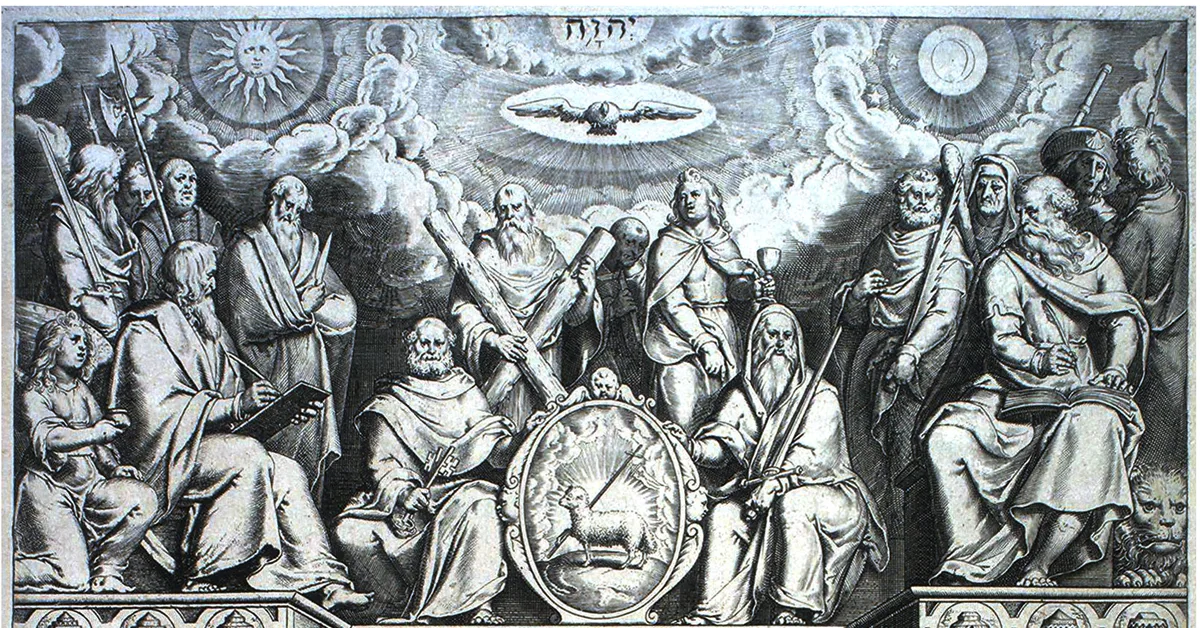
Some of these meanings are in the text. Some were added later.
Claims about biblical numbers come in three different kinds.
Sometimes the text states the meaning outright. Genesis, the opening book, doesn’t merely count seven days and stop. It tells you what the seventh day is for: God rested on it, then “blessed the seventh day, and sanctified it.”1
Sometimes the text interprets its own number. The prophet Jonah spends three days and three nights inside the great fish that swallows him. The gospel of Matthew picks that detail up and turns it into a figure, the sign of the prophet Jonas: “For as Jonas was three days and three nights in the whale’s belly; so shall the Son of man be three days and three nights in the heart of the earth.” Nothing has been imported from outside. One part of the Bible is reading another, a move the tradition calls typology.
Sometimes the text hands us a number and invites us to reach our own conclusions. John’s gospel counts the fish in the net when the risen Jesus meets his disciples by the shore, “an hundred and fifty and three,” exactly, and offers no further explanation. Everything 153 has ever meant was supplied by someone later. We can usually say who, and when, and follow the reasoning they used.
Figure 1.Every number, and who supplied its meaning
Every number this page covers, and where its meaning came from. Follow a number to its full entry below; the two with no entry of their own carry their sources here instead. Counts are of the King James Version, Project Gutenberg ebook #10, a 1611 English translation rather than the Hebrew and Greek beneath it.
From the text itself
- Stated8
- Read by the text2
From a named reader
- Supplied5
From nobody we could find
- No meaning found2
1not counted, also a pronoun and an article
Stated
Oneness itself is the claim, not a count of anything.
2639× in the KJV
Stated
The minimum testimony that establishes a matter; one witness is explicitly not enough.
3358× in the KJV
Read by the text
Matthew reads Jonah’s three days as a figure for three more, so the Bible supplies its own reading.
3½not counted, written three different ways
Stated
A bounded stretch of trouble. The equivalence is the book’s own arithmetic, laid out inside the text.
4203× in the KJV
Stated
Everywhere, in every direction; the text’s own word for extent.
5185× in the KJV
No meaning found
None. The text attaches no meaning to five, and none of the sources below supplies one.
6103× in the KJV
Supplied
Six is the first perfect number (its divisors add up to itself), so the world was made in six days because six was already perfect.
7376× in the KJV
Stated
Rest, and the first thing the Bible sets apart as holy, which is a unit of time, not a place.
833× in the KJV
Read by the text
1 Peter reads the eight saved through water as a figure for baptism, so a later book supplies the count and its meaning together.
917× in the KJV
No meaning found
None. The text attaches no meaning to nine, and none of the sources below supplies one.
10176× in the KJV
Stated
A complete set, counted and labelled on the page rather than by a reader.
12156× in the KJV
Supplied
Three times four (the Trinity times the quarters of the globe), read as the Church reaching the whole world.
4093× in the KJV
Supplied
Ten taken four times: knowledge laid across time, four being the divisions of the day and the year.
7060× in the KJV
Stated
A fixed term with an end announced in advance.
1531× in the KJV
Supplied
The sum of every whole number from one to seventeen, seventeen being ten plus seven; and, by another route, fifty taken three times plus three.
6664× in the KJV
Supplied
Three candidate names that total 666 in Greek (Evanthas, Lateinos, Teitan), with Teitan rated highest and the question deliberately left open.
144,0003× in the KJV
Stated
Twelve thousand from each of twelve tribes. The multiplication is the text’s own and it is done in the open, across four verses.
2 of these 17 carry no meaning at all: none given in the text, and none supplied by any source below. They’re listed anyway. Leaving them out would make the table look complete when it isn’t, and five is among the most searched numbers here.
All 17 rows, each with its verses, its count and who supplied its meaning: JSON · CSV · CC BY 4.0 · last updated 2026-08-15
Which numbers the text actually leans on
The Bible never ranks its own numbers. No verse calls one of them holiest, and the readers who came later reached for different ones. What we can do is count them.
Numbers thin out as they get larger, in the Bible as in any other book: two turns up more often than three, three more often than four, and so on down the slope. A few numbers sit conspicuously above it.
Seven is used 376 times in the King James text. Six manages 103 and eight only 33, so seven runs about five and a half times its immediate neighbours. It’s also used more often than three, four, five or six, which isn’t how counting usually behaves. Twelve is starker: 156 against eleven’s 21 and thirteen’s 14, close to nine times the numbers on either side of it.1
Ten does better than both, at a little over nine times its neighbours, and that one isn’t mysterious. We count in tens, so ten and twenty and a hundred and a thousand accumulate uses in any language spoken by people with fingers. Ten is an expected result rather than a find: it shows the count picking up an ordinary rounding habit, which is what it should do. Seven and twelve aren’t round numbers in base ten, and they rise anyway.
Forty appears 93 times. Thirty appears 80 times, and fifty 83. The number of the flood and the wilderness and the fast sits a little ahead of the decades either side of it, and nowhere near the gap that seven and twelve open up.


Every count on this chart: JSON · CSV · CC BY 4.0 · doi.org/10.5281/zenodo.21968922
One, and the idea the whole Bible rests on
Deuteronomy’s use of one isn’t a count. The Shema, which observant Jews recite twice a day, opens “Hear, O Israel: The LORD our God is one LORD,” and the oneness is the point. The tradition’s central idea turns out, in an intriguing way, to be a statement about number.
Mark has Jesus quote it back when he’s asked which commandment comes first, and it arrives with the number intact: “The first of all the commandments is, Hear, O Israel; The Lord our God is one Lord.”1 The meaning is stated where the number first appears, and stated again when the New Testament picks it up.
Two, and the rule that needs a second voice
Two is the number the Bible reaches for most, at least among the numbers we can count: 639 uses, against seven’s 376. Deuteronomy, which carries the law, is blunt about two. “One witness shall not rise up against a man for any iniquity, or for any sin, in any sin that he sinneth: at the mouth of two witnesses, or at the mouth of three witnesses, shall the matter be established.”1 A capital case gets the same rule and the same refusal: at the mouth of two or three a man may be put to death, “but at the mouth of one witness he shall not be put to death.”
The New Testament keeps both the rule and the wording. “Two or three witnesses” turns up four times in those words, in the gospel of Matthew, the second letter to the Corinthians, the first letter to Timothy and Hebrews. John’s gospel goes one step further and names what it’s quoting: challenged over his own testimony, Jesus answers that “it is also written in your law, that the testimony of two men is true.”
Three, and the moment the text reads itself
Three arrives with a rhythm rather than a tally. Jonah’s three days in the fish are one instance of it, and the gospel of Matthew reads that stretch of time as a figure for Jesus in the grave. Peter, the disciple who’d sworn he would never abandon Jesus, is warned that “before the cock crow, thou shalt deny me thrice,” and does exactly that before the night is out. And the phrase “the third day,” which carries the resurrection, turns up fifty-two times across the Bible.
The count is particularly interesting here, because it cuts against what we might expect. Three is used 358 times, a great many, and yet it sits about where the slope predicts: two is commoner, four rarer, and three doesn’t stand above its neighbours the way seven and twelve do. What makes three feel ubiquitous is where it falls rather than how often. It marks the beat at which something resolves, and the ordinal bears that out: “third” is used almost as often as “second,” and twice as often as “fourth.”
One thing attached to three isn’t in the text at all. The word “trinity” appears nowhere in the King James Bible. What’s there is the baptismal formula, as when Matthew’s gospel ends by telling the disciples to baptise “in the name of the Father, and of the Son, and of the Holy Ghost.” Augustine treats the doctrine as settled and finds a trinity in the Creator. He makes three the life as well, counted as heart, soul and mind, and he counts history in threes, before the law, under the law, and under grace.2
Three and a half, and the span the text measures three ways
Revelation, the Bible’s last book and its strangest, keeps returning to one stretch of time. The holy city is given to the Gentiles and trodden underfoot for “forty and two months,” and the beast that rises out of the sea, the one whose number is 666, is given power for exactly as long. Two witnesses are appointed to prophesy, in the sackcloth of mourning, for “a thousand two hundred and threescore days.” A woman crowned with twelve stars flees a dragon into the wilderness and is fed there for the same 1,260 days, then, later in the same chapter, for “a time, and times, and half a time.”1
Forty-two months is 1,260 days at thirty days to the month: three and a half years. The equivalence is asserted by use: the book measures one span three ways and expects us to follow. Nothing was left for a later reader to supply, because the arithmetic is laid out inside the text. Elsewhere the Bible says it plainly enough; Luke and James both give the length of the drought the prophet Elijah called down as “three years and six months.”
Perhaps coincidentally, or not, three and a half is also half of seven, the number of days it took for all things to be created plus a day of rest. The five passages use it consistently: the city trodden, the witnesses in sackcloth, the woman in flight, the beast in power. Each is a stretch of trouble with a limit on it.
The third phrasing is borrowed. Daniel, an older book of visions, has “a time and times and the dividing of time,” and again, in its closing chapter, “a time, times, and an half.”
Four, and the whole earth in every direction
Four is the Bible’s own word for everywhere. Isaiah, a book of prophecy, promises that the scattered of Israel will be gathered “from the four corners of the earth,” and Revelation posts four angels on those same corners, holding “the four winds.”
Those winds recur nine times, most of them in the prophets, and they work in both directions. Jeremiah brings them “from the four quarters of heaven” to scatter a people. Zechariah has God spreading a people abroad “as the four winds.” Ezekiel, in a valley of dry bones, calls breath into the dead “from the four winds,” and they stand up on their feet.1
The holy city that comes down out of heaven at the end of Revelation has twelve gates, and the passage sets them out by direction: “On the east three gates; on the north three gates; on the south three gates; and on the west three gates.”
Later readers attached more to it. For Augustine four was the body, made of four elements; it was also time, a day and a year each falling into four parts;2 and the four quarters of the globe were what he multiplied into twelve.3
Five, and the count that stayed a count
Five turns up 185 times, more often than six, eight or ten. It’s a common number that never got a job. Five loaves feed a crowd; five of the ten virgins in the parable are the wise ones. In both the five is a quantity and nothing else. No verse says what five is for, and none of the sources here supplies one.
Six, and the week that followed from the number
In Genesis, God creates all things in six days, though a reason for precisely six days is never given. Augustine of Hippo, writing The City of God early in the fifth century, supplies a reason. Six isn’t perfect because the world was made in six days. The world was made in six days because six was already perfect.
Perfect is arithmetic here rather than praise. A perfect number is one whose divisors add up to the number itself, and six is the first of them: it divides by one, two and three, and one plus two plus three makes six. Augustine works it out on the page. “The number six is the first which is made up of its own parts,” he writes, “of its sixth, third, and half, which are respectively one, two, and three, and which make a total of six.”
Only then does he turn to Genesis. “These works are recorded to have been completed in six days,” he writes, “because six is a perfect number.”4
The interpretation of Genesis wasn’t originally his. Philo of Alexandria, a Jewish philosopher writing in Greek in the first century, had read the six days the same way four hundred years earlier, calling six “the first perfect one, being made equal to its parts.”5
Seven, and the day the story stops on
Seven is the number the Bible explains at its first appearance. Genesis finishes the creation account on the seventh day, “and he rested on the seventh day from all his work which he had made,” then blesses that day and sets it apart, “because that in it he had rested.” The meaning arrives attached to the number.
It’s worth noticing what kind of thing is being set apart. In the King James text, “sanctified” appears here for the first time, and what it applies to is a day. The word “holy” doesn’t turn up at all until Moses at the burning bush, in the next book, where it lands on a patch of ground. The first thing Scripture marks off as different from everything around it is a unit of time.
The number then keeps coming. Seven is used 376 times in the King James text, about five and a half times as often as the six and the eight on either side of it. Seven days occurs ninety-five times, seven years thirty-three, seven times thirty-five, spread across law, history and prophecy rather than pooling in one book. Revelation, which is short, uses seven 54 times on its own: seven churches, seven golden candlesticks, seven seals, seven trumpets, seven angels, and “the seven Spirits which are before his throne.”1
That concentration is where the modern habit of calling seven the number of Jesus comes from. There’s no single verse that attributes the number seven to Jesus, but the text crowds sevens around him: Revelation opens by addressing seven churches, and the figure who appears in the first chapter holds seven stars in his right hand.
The meaning printed almost everywhere else is completeness, and that one has an owner. Philo of Alexandria, who explained the six days by the perfection of six, says that people who use words carefully call seven “the perfecting number; because by it, everything is perfected.”5 He isn’t coining it. He’s reporting a usage already in circulation in the first century, which is as far back as we can follow it.
Augustine had a slightly different interpretation. Writing On Christian Doctrine, he built seven out of its parts. Three is the life, which is why “God is to be loved with the whole heart, the whole soul, and the whole mind.” Four is the body, made of four elements. Three plus four, life plus body, which for him made seven the number of the creature rather than of the Creator.2 In his sermons on John he uses it differently again, as the number of the Spirit.6
Eight, and the count a later book supplies
The eighth day is fixed early and never moves. In Genesis, it’s part of the covenant with Abraham, “he that is eight days old shall be circumcised among you,” and Abraham circumcises Isaac on schedule. The phrase “the eighth day” recurs twenty-one times, which is a lot of attention for a number the Bible otherwise uses sparingly, and it’s still running in Luke’s gospel, where the neighbours arrive on the eighth day to circumcise the son of Zacharias and find his mother insisting the child be called John.
The other eight belongs to the flood. The first letter of Peter looks back at the ark and counts the people in it: “few, that is, eight souls were saved by water.” Then it says what that number is for. “The like figure whereunto even baptism doth also now save us.”1
Genesis never counts them. It names them: Noah and his wife and his three sons and their three wives.
Nine, and the hour on the clock
Nine is the rarest of the small numbers, at 17 uses, fewer even than eleven. Most of them aren’t counting anything. They’re the ninth hour, mid-afternoon, when Jesus cries out on the cross and when Peter and John go up to the temple to pray. It’s a position in the day, and no verse or commentator here turns it into more than that.
Ten, and the count the text makes itself
Ten is a number the Bible counts out loud. Exodus names the count on the tables themselves, “the words of the covenant, the ten commandments,” and Deuteronomy gives the figure twice more. The tally and the label both come off the page.
The plagues of Egypt work the other way. Exodus delivers them one at a time, blood and frogs and lice on through the death of the firstborn, and never adds them up. The phrase “ten plagues” appears nowhere in the King James text; that count is ours.1
Augustine, having built seven out of life and body, assembled ten the same way: “the number ten signifies the knowledge of the Creator and the creature, for there is a trinity in the Creator.” Three for the Creator, seven for the creature.2 In his sermons on John he uses ten more plainly, for the law the commandments spell out.6
Twelve, and who did the multiplying
The twelves in the Bible are counts. Twelve tribes appears ten times, twelve apostles three, twelve disciples four more. Revelation stacks them up: the woman crowned with twelve stars, and at the end a city with twelve gates and twelve foundations. In none of them does the text say what twelve means.1
The explanation that twelve is three times four is Augustine’s, and it has an address. It sits in his commentary on the psalm his Latin Bible numbered 86 and ours numbers 87, the one about the gates of Zion. “There are four quarters of the globe: East, West, North, and South: and they are constantly alluded to in the Scriptures.” The Church is called from all four of them, and called by baptism, in the name of the Father and the Son and the Holy Ghost. “Four then being thrice taken, twelve are found.”3
Both halves of that sum come from outside the verse. The four is the text’s own, in the sense the four corners and the four winds give it. The three isn’t, since the word trinity is nowhere in the text. Scripture supplies the twelve, and Augustine supplies the three and the four.
The point he’s making isn’t a headcount either. He’s reading the twelve thrones as a figure for the Church reaching the whole world, and the thrones turn out not to be limited to the men who were there: they belong not only to “those twelve, and the Apostle Paul,” but, “from the universal signification, all who are to sit in judgment.”
Forty, and the meaning nobody signed
Forty is the number the Bible repeats hardest. “Forty days and forty nights” occurs eleven times, in the rain that floods the earth, on the mountain where Moses waits in the cloud, and in the wilderness where Jesus fasts before he’s tempted. “Forty years” occurs forty-three times, four of them in the phrase that carries the whole desert generation, forty years in the wilderness.1
The counting of forty is less dramatic than we might have initially expected. It’s used 93 times, against thirty’s 80 and fifty’s 83, so it sits a shade ahead of the decades either side and nowhere near the gaps that seven and twelve open up. What makes forty feel enormous is that the same phrase keeps returning at the moments the story turns.
The meaning usually attached to it is testing, or probation, or preparation. It fits the text well enough and it’s printed almost everywhere, and we haven’t found anyone to attribute it to. No verse says it, and no commentator we’ve read claims it.
Augustine’s forty is a different thing. Explaining in On Christian Doctrine why Moses and Elijah and Christ each fasted forty days, he splits the number in two: “the number contains ten four times.” The ten stands for knowing things. The four stands for time, because a day falls into morning, noon, evening and night, and a year into spring, summer, autumn and winter. Forty is knowledge laid across time, and what he asks of a reader is forty days of declining whatever time offers.2
Seventy, and the number with a deadline
Seventy is the one that comes with a term attached. The prophet Jeremiah tells a people about to lose their country exactly how long the loss will run: these nations “shall serve the king of Babylon seventy years,” and when the seventy “are accomplished,” the king of Babylon will get his turn. Elsewhere the number counts people instead of years, the seventy elders who go up the mountain with Moses.
Its relation to seven is something the text does itself, twice. In Genesis, Cain’s descendant Lamech tells his two wives that he has killed a man, and boasts that “if Cain shall be avenged sevenfold, truly Lamech seventy and sevenfold.” In Matthew, Peter asks how often he should forgive a brother who keeps wronging him, and proposes a number himself: “till seven times?” He’s told, “I say not unto thee, Until seven times: but, Until seventy times seven.”1 Both scenes take a seven that’s already on the table and answer it with seventy. One is a boast about killing, the other an instruction to forgive.
A hundred and fifty-three, and the same man's two answers
The fish get counted and that’s all. John’s gospel has the risen Jesus meet his disciples at the shore, and when they haul the net in, the figure is exact: “an hundred and fifty and three.” The Bible doesn’t give this unusually precise number any particular meaning.
Augustine does, in two different books, by two different routes.
In his sermons on John, he builds the number out of ten and seven, the law and the Spirit, which make seventeen. Add up every whole number from one to seventeen and the total is a hundred and fifty-three. He does the sum on the page: “if you add 2 to 1, you have 3 of course; if to these you add 3 and 4, the whole makes 10.” Keep going to seventeen and you arrive.6
In On Christian Doctrine, he gets there another way. Fifty taken three times, either for the three divisions of time or for the Father, Son and Holy Ghost, makes a hundred and fifty, and then the Trinity itself is “added over and above.”2
Both sums are correct: one to seventeen adds up to a hundred and fifty-three, and so does fifty times three plus three.
Six hundred and sixty-six, and the calculation the text doesn't finish
666 appears four times in the King James Version, and three of them are accountancy. Twice it’s a revenue figure: the gold that came to Solomon, the king who built the temple at Jerusalem, “in one year was six hundred threescore and six talents.” Once it’s a line in the register of families coming back from exile in Babylon, “the children of Adonikam, six hundred sixty and six.”
The fourth is Revelation 13:18. “Here is wisdom. Let him that hath understanding count the number of the beast: for it is the number of a man; and his number is Six hundred threescore and six.”1 The instruction is there in the verse; what isn’t there is the answer.
Irenaeus, the bishop of Lyons, took the invitation up around the year 180, in the book we call Against Heresies, and his is the earliest attempt that has survived. He’s working in Greek, where the letters double as numerals so that every name comes with a total attached, and he puts forward three that come to 666: Evanthas, Lateinos and Teitan. Lateinos he calls a very probable answer, since the Latins are the people ruling at the time he’s writing. Teitan he rates highest of the three. Then he stops, deliberately, and says why: “if there are many names found possessing this number, it will be asked which among them shall the coming man bear.”
He knows about the rival number, too. Some manuscripts of Revelation circulating in his own day read 616 instead of 666, and he puts that down to scribes: “I am inclined to think that this occurred through the fault of the copyists.”7
Nero is not among his three. The reading almost everyone has heard, that the number spells out the Roman emperor Nero Caesar in Hebrew letters, first turns up among German scholars in the 1830s, roughly seventeen centuries after Revelation was written. No surviving early commentary on Revelation proposes him, a point conceded by Kenneth Gentry, who argues for the Nero reading himself. Francis Gumerlock, whose 2006 paper collects the patristic evidence for that reading, thinks Irenaeus very likely knew the Nero identification anyway, inferring as much from those same remarks about 616.
The one ancient text that does reach for Nero’s name is a fifth-century chronicle from North Africa, the Liber Genealogus. It assigns values to the letters of ANTICHRISTVS, adds them to 154, and multiplies by four, “according to the four letters of the name of Nero.” That gives 616. The compiler then appends three candidates from an older commentary, Teitan among them, because the total from Nero’s name “did not agree” with the number of the beast.8
A hundred and forty-four thousand, and the number the text counts out
Lifted directly from Revelation: “And I heard the number of them which were sealed,” the vision runs, “and there were sealed an hundred and forty and four thousand of all the tribes of the children of Israel.”1 Sealed here means marked on the forehead and set aside from the harm that’s coming.
Notice that the number was stated outright, but the passage then spends four verses counting it out. Twelve thousand from Juda, twelve thousand from Reuben, twelve thousand from Gad, on through twelve tribes, a line apiece. The multiplication is the text’s own, and it’s done in the open.
They aren’t quite the usual twelve, either. Dan is missing from the list, and Levi is on it, though Numbers keeps the Levites out of the tribal count.
The same units turn up again in the city at the end of the book, which has twelve gates, twelve foundations under its wall, and a measurement of twelve thousand furlongs. The wall itself comes to 144 cubits.
What this page doesn't answer
People arrive at this material with a second question attached: whether finding meaning in biblical numbers is something a believer ought to be doing at all. Whether it’s a sin. Whether the Bible forbids it.
That one we don’t answer. It’s a question about what a tradition permits its members, and it gets settled inside a tradition, by people who hold authority there, on grounds that aren’t historical or arithmetical. We have neither the standing nor the vantage point. A rabbi, a priest, a pastor, and your own reading are the right addresses.
Declining it isn’t the same as answering it quietly in the negative, or in the positive. The history above is neutral on the question, and so are we.
Notes: where the neighbours are
Gematria. Adding up the letters of a word or a name to get a number is a related practice and a separate one, with a long history of its own and its own page here. This page brushed against it once, where Irenaeus totted up Greek names looking for one that came to 666.
Modern numerology. The numerology sold today mostly works on a person. You give it a birth date or a name, it adds the digits down to a single digit, and it reads that digit as character or fortune. What separates it from everything above is what the number is attached to. Biblical numbers are quantities inside a narrative, forty days of rain, twelve tribes counted out one tribe at a time, and nobody reduces forty days to four.
Why there’s nothing here to calculate. A numerology calculator needs you to supply the input, your own date or your own name. The numbers on this page arrived with the text, and they’re the same for every reader who opens it.
Names and dates attached
Genesis explains the seventh day itself. Matthew’s gospel reads Jonah’s three days as a figure for three more. A hundred and fifty-three turns into the sum of one to seventeen in a sermon on John, and 666 collects three candidate names from a bishop in Lyons around the year 180. Forty is the exception, still carrying a meaning we couldn’t trace to anybody.
What the numbers meant to the people who first wrote them down, the text mostly leaves open. What they’ve meant since is a matter of record, with names and dates attached.
Keep reading
How we did this
- The corpus
- Every count on this page comes from the King James Version, in Project Gutenberg's text of it. That's a 1611 English translation rather than the Hebrew and Greek underneath it, which is one of the limits listed in what would show this page wrong.
- How we counted
- Biblical Hebrew writes its numbers as words, and the King James follows, so there are no digits to count. We counted the words instead, compounds included: "six hundred threescore and six" registers as a single 666 rather than as a six, a hundred and another six. Without that step, a search for 666 turns up nothing in the Bible at all. The same rule works in reverse: "eight hundred and seven years" is an 807 rather than a seven, so it never reaches the count of sevens. Line breaks were flattened before matching, because the source file wraps phrases across lines. One is parsed but kept out of the curve, since "one" in English is also a pronoun and an article. The verse lists in each entry are counted a second way, by verse rather than by occurrence, which is why a phrase falling twice in one verse is listed once.
- The sort is ours
- Sorting the meanings into three kinds is ours, not a scheme we took from a source.
References
- The Holy Bible, King James Version (1611) Project Gutenberg ebook #10, the single file behind every quotation and every count here. A 1611 English translation rather than the Hebrew and Greek beneath it, which is the limit named in the falsification box.
- Augustine of Hippo, On Christian Doctrine, Book II (II.16.25), trans. J. F. Shaw The busiest source here. Carries seven as three plus four, ten as three plus seven, forty as ten taken four times, the second derivation of 153, three as the life ("the whole heart, the whole soul, and the whole mind"), and history in threes, before the law, under the law, and under grace.
- Augustine of Hippo, Exposition on Psalm 87 "There are four quarters of the globe… Four then being thrice taken, twelve are found." His Latin Bible numbers this psalm 86 and ours numbers it 87, which is why the page cites it both ways.
- Augustine of Hippo, The City of God, XI.30, trans. Marcus Dods Six as the first perfect number, and the six days of Genesis read in that light. Quoted verbatim from Dods; the punchier version in wide circulation is a compression of it.
- Philo of Alexandria, On the Creation, chs. III and XXXIV, in The Works of Philo Judaeus, trans. C. D. Yonge (1854) Two passages. Chapter III has the same reading of the six days four centuries before Augustine; that Augustine took it from Philo is not claimed here, only that the reading is older than him. Chapter XXXIV is the earliest attestation we found for the popular meaning of seven, and Philo does not claim that one either, reporting "the perfecting number" as usage already in circulation.
- Augustine of Hippo, Tractates on the Gospel of John, Tractate 122 The first derivation of 153, as the triangular number of seventeen, plus seven as the Spirit and ten as the law. The tractate is on John 20:30–21:11, which is the passage that counts the fish.
- Irenaeus of Lyons, Against Heresies, V.30 (c. 180) Evanthas, Lateinos and Teitan; Teitan rated highest; the deliberate refusal to settle on one; and the 616 variant put down to the fault of the copyists. The earliest surviving attempt at the number of the beast.
- Francis X. Gumerlock, "Nero Antichrist: Patristic Evidence of the Use of Nero's Name in Calculating the Number of the Beast (Rev 13:18)", Westminster Theological Journal 68 (2006), 347–360 The Liber Genealogus material, and the argument that Irenaeus very likely knew the Nero reading anyway. Also where Kenneth Gentry reaches us: Gumerlock quotes him, a proponent of the Nero reading, conceding that no early Church father proposes Nero, and that sentence on this page is sourced here rather than to Gentry directly.
- Numeluna, Number-word frequency in the King James Bible dataset, 2026; archived at Zenodo under CC-BY 4.0 with the DOI 10.5281/zenodo.21968922 — the permanent, citable copy of the counts behind Figure 2, generated from the same Gutenberg text quoted above.
Cite this page
Numeluna. What numbers mean in the Bible. Published . https://numeluna.com/bible-number-meanings/