Numerology Guide
Numerology, explained
Numerology is the practice of turning a birth date or a name into a small number, usually from 1 to 9, and reading a meaning off it. That's the short answer, and you're welcome to take it and go. The longer one runs from an Assyrian inscription to a 1905 book about vibration.
By NumelunaPublished
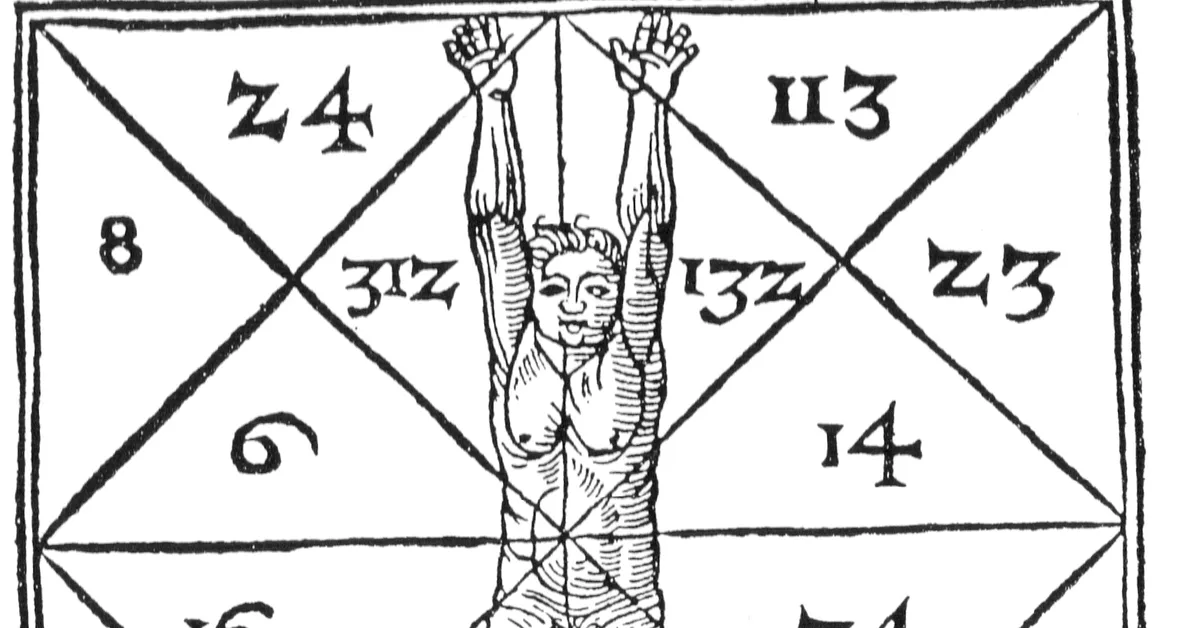
What numerology is
Numerology takes something about you and turns it into a small number, usually from 1 to 9, then reads a meaning off that number. Every calculation is the same two moves: convert it into digits, then reduce those digits until one is left.
That sentence holds two things with different histories. The arithmetic is the reducing: add the digits, keep going until one is left, give each letter a number. The meanings are what a 4 or a 7 is said to stand for, and those were gathered over a very long time, from many traditions.
People come to it for many reasons: to understand themselves better, to have something to hold a decision up against, or out of plain curiosity about where the numbers came from. What changes from one number to the next is only which part of you goes in: the date you were born, the letters of your name, the vowels alone, the consonants alone, the single day of the month. Each one starts from a different part of you.
How numerology is calculated
Reduction is the one rule underneath everything. You add up the digits, and if the total is bigger than 9, you add its digits together too, and you keep going until a single digit is left. Here is a birth date worked all the way down:
14 March 1988
Day14 → 1 + 4 = 5
Month3 → 3
Year1988 → 1 + 9 + 8 + 8 = 26 → 2 + 6 = 8
Total5 + 3 + 8 = 16 → 1 + 6 = 7
That birth date comes to 7, the number numerology calls the Life Path. The day, month, and year are each reduced on their own first, then those three are added and reduced once more. If you’d rather not do the sums, the Life Path calculator works it out from your birth date.
The one exception to the reducing is the master numbers.
Master numbers
When a total comes to 11, 22, or, for some practitioners, 33, you leave it as it is instead of adding its digits. These are the master numbers.
Each still sits above the single digit it would fold into, and keeps that digit underneath it: an 11 carries the 2 (1 + 1), a 22 carries the 4, a 33 carries the 6. The reading holds that a master number is a stronger, harder-to-live-out form of the digit below it, the 11 as a more demanding 2 and the 22 as a more demanding 4. If your total lands on one, read the digit underneath it too, since the two are meant to be read together.
The idea is modern, and so is the term. L. Dow Balliett, an American New Thought writer, used it in her Philosophy of Numbers (1908) for 8, 9, 11 and 22, and meant a mastery a person arrives with.1 Which numbers count has changed since, and practitioners still split on 33.
Turning letters into numbers
Some of the numbers start from your name rather than your birth date, so they need a way to turn letters into digits. The common method is the Pythagorean chart: the alphabet laid out in nine columns, each letter taking the number above it.
Here is that same fixed rule as one image, worth saving or citing on its own: the version to screenshot, download, or link back to, rather than the live widget above it.
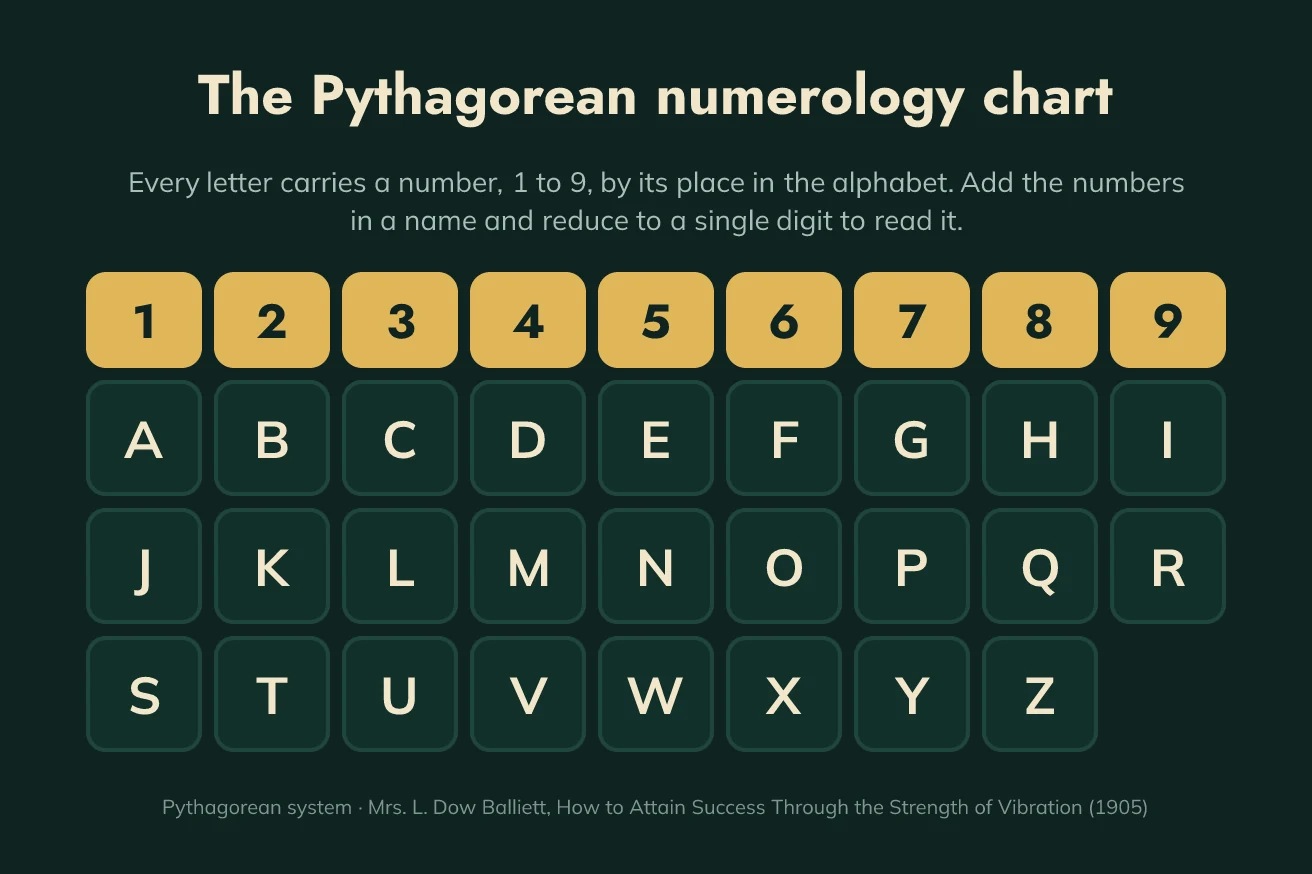
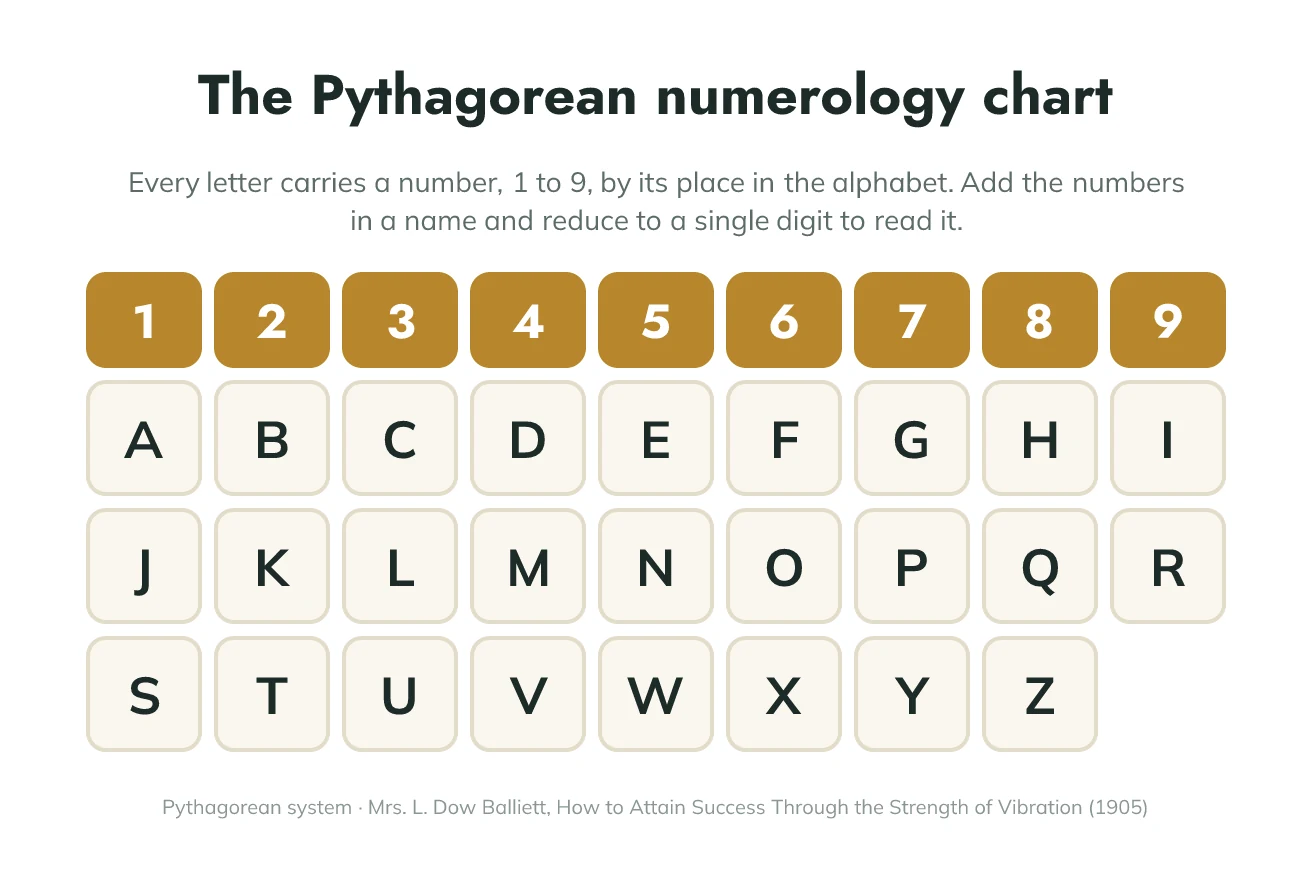
A fixed rule, not a house style: every letter’s value comes from its place in the alphabet, so any two people working the same name land on the same number. Also on Wikimedia Commons, CC BY 4.0.
Source: Mrs. L. Dow Balliett, How to Attain Success Through the Strength of Vibration (1905), p. 14.png)
From here the three name numbers just differ in which letters they count. The Expression uses every letter. The Soul Urge uses the vowels alone. The Personality uses the consonants. Each column’s letters add up, then reduce by the same rule as any date.
Turning letters into numbers is old. Gematria is attested in an Assyrian inscription from the 8th century BCE,2 and in 1533 Cornelius Agrippa gave the Latin letters number values too, though his ran up to 500 rather than stopping at 9.3 Reading a name’s vowels as its spiritual side and its consonants as the body comes later: Balliett does it in The Day of Wisdom (1917).4
The five numbers people usually mean
Five numbers are usually called your core: the Life Path, from your birth date; the Birthday, from the day of the month you were born; and three from your name, the Expression, the Soul Urge and the Personality.56 Work out any of them below, or see how they fit together on the numerology chart, the map of the whole set.
- Life Pathfrom your birth date
the temperament the tradition leans on hardest.
- Expression · Destinyfrom every letter of your full birth name
what you can do out in the open.
- Soul Urge · Heart's Desirefrom the vowels of your name
what you privately want.
- Personalityfrom the consonants of your name
the face you show a room before you speak.
- Birthdayfrom the day of the month you were born
one specific gift you were handed.
Not every author groups them this way. Balliett, in 1905, worked with three: a number for the whole name, one for its vowels and one for the date of birth.7 Other books draw the lines in other places.
The sites that use this set list the Life Path first, and it is the one worked from your birth date. Each of the nine has its own write-up, with the temperament it’s said to carry and the strengths and blind spots that go with it:
What each number means
Apart from any Life Path, each digit has a page of its own on what the number is said to mean and where that meaning came from:
Where numerology comes from, and when each part arrived
The study of what numbers mean is old and traceable. The Greeks called it arithmology, and its surviving handbooks come from around 100 CE onward: Nicomachus of Gerasa’s Introduction to Arithmetic,8 and the Theology of Arithmetic, attributed to Iamblichus, which draws on Nicomachus and on a second Greek writer, Anatolius, and is our fullest source for what each number was said to mean.9 The tradition runs back roughly 2,400 years.
Turning a name into a number is old too, and it was used to read people long before anyone spoke of a Life Path. In the early third century the Christian writer Hippolytus described Greek practitioners who reduced two names to a single digit by the rule of nine, to say which of two men would win a contest.10 Agrippa’s Occult Philosophy (1533) prints a rule for finding the ruling star of anyone born: add the letter values of their name and both their parents’ names, divide by nine, and the remainder names the planet.3 And in Egypt in the 1830s the English Orientalist Edward William Lane recorded that people worked out which sign of the zodiac governed a person, and whether a couple would agree, from the values of their names.11
In each of these the total is looked up in something else: a winner, a planet, a sign. The numerology you can look up today does something different: it reads the total against what the number itself is said to mean, and takes the result as a description of you, from a name, its vowels and a birth date together. The earliest text we have found that does all of it is L. Dow Balliett’s How to Attain Success Through the Strength of Vibration, from 1905.7 Her worked example is a man called John Ellicott, born 30 October 1877. His name comes to 8 and his birth date to 9 (1 + 3 + 5), and she reads his “character and capabilities” from the two.7
The word has a shorter history of its own. Numerology was printed in 1871 in a different sense altogether, the general science of number, by the American writer Stephen Pearl Andrews, who was giving every domain of being its own -ology.12 The first place we have found it in its occult sense is a bookseller’s advertisement in the Bombay Gazette of 13 December 1907, for a book called Number, Name and Colour.13 Balliett called what she did number vibration.
The arithmetic of names is old and was used to read people more than once. The system taught today, with a name, its vowels and a birth date read together as a description of you, is documented from 1905.
How firm these dates areaside
This dating is our reading of the texts we have found, not any one source’s, and an earlier text that does all of it at once would move it. Merriam-Webster gives 1884 for the occult sense without naming a source; December 1907 is the earliest use we have seen in print. None of the Balliett books we read uses the word.
In dates, the line runs from the Pythagoreans to the number descriptions you’ll find online today:
- 6th c. BCE
The Pythagoreans
A Greek school treats number as the key to cosmic order. No writings survive, so everything “Pythagoras taught” is later reconstruction, not his own words.
- c. 100 CE
Nicomachus of Gerasa
His Introduction to Arithmetic becomes the standard Greek handbook of number theory, the arithmetic that later number symbolism sits on.
- 2nd–4th c. CE
The Theology of Arithmetic
The longest surviving ancient work on number symbolism, attributed to Iamblichus and compiled from Nicomachus and Anatolius. It is our fullest source for what each number was said to mean.
- c. 500 CE
Boethius
Renders the Greek number theory into Latin, the pipe through which it reached medieval Europe and stayed standard curriculum for roughly a thousand years.
- 1533
Cornelius Agrippa
Occult Philosophy, Book II systematizes each number’s “virtue” and maps values onto the alphabet, a bridge from cosmic symbolism toward letter-based numerology.
- late 1800s
The occult revival
Theosophy and popular showmen like Cheiro turn number divination into mass entertainment; the letter-number systems consolidate.
- 1905–1917
Balliett, the personality turn
American New Thought writer L. Dow Balliett reads a name, its vowels and a birth date together as character, from How to Attain Success Through the Strength of Vibration (1905) on. It is the earliest text we have found that does all of it.
- 1970s–90s
Mass-market profiles
Books like Javane & Bunker (1979) and Dan Millman (1990) codify the per-number personality profiles now standard across the web.
The luck that East Asia attaches to numbers has a different source: four is avoided and eight sought after because of what the words sound like.
The questions that come next
What does the Bible do with numbers? Scripture uses them constantly, and that page takes the main ones one at a time.
Which number is the luckiest? It depends on the country. That page looks at what 4 and 8 do to elevator panels and prices in East Asia.
What is the rarest Life Path? With 33 counted as its own path, as some practitioners do, it is the rarest: 0.35% of birth dates across a full 400-year calendar cycle, against 11.11% for a 7.
Is numerology real? That question has a page of its own.
What about angel numbers? They are built on the same digits: 333 is read through the 3, and that page takes each sequence in turn.
Where does Pythagoras come in? His school’s teaching reaches us through later writers, and that page follows it from there.
How to read your numbers
A number works well as a lens: hold it up against your own life and see what fits. What fits you can keep, and what doesn’t you’re free to leave.
Work out your number, read where its meaning came from, and decide what to do with it. What have you been hoping a number might tell you?
Keep reading
References
- L. Dow Balliett, The Philosophy of Numbers: Their Tone and Colors (1908; 5th ed. 1917) — the New Thought reworking of number symbolism into character; it names "master numbers" and lists 8, 9, 11 and 22 among them.
- Gematria: the Sargon II inscription (727–707 BCE) The earliest attested letter-as-number practice, Assyrian rather than Jewish; documented in the Encyclopaedia Judaica.
- Cornelius Agrippa, Three Books of Occult Philosophy Book II, ch. 20 (1533; Freake trans., 1651) — letters given number values running to 500, and the rule of nine for "the ruling Star of any one that is born".
- L. Dow Balliett, The Day of Wisdom (1917) — vowels as the "spiritual" part of a name and consonants as "the body".
- Hans Decoz, World Numerology: the most important numbers in your chart Five core numbers: Life Path, Birth Day, Expression, Soul Urge and Personality.
- Numerology.com, Your Core Numbers: the five most important numbers in your chart The same five, Life Path first.
- L. Dow Balliett, How to Attain Success Through the Strength of Vibration (© 1905; read in the 1913 printing) — a name digit, a vowel digit and a birth-date digit read together as "character and capabilities"; the worked example is John Ellicott, born 30 October 1877.
- Nicomachus of Gerasa, Introduction to Arithmetic (c. 100 CE; D'Ooge trans., 1926) — the arithmetic the later number symbolism sits on.
- Iamblichus (attrib.), The Theology of Arithmetic (Waterfield trans., 1988) — compiled from Nicomachus and Anatolius; the fullest surviving ancient work on what each number was said to mean.
- Hippolytus, Refutation of All Heresies Book IV, ch. 14 (early 3rd c. CE) — a name reduced to a digit by the rule of nine, to say which of two men wins a contest.
- Edward William Lane, An Account of the Manners and Customs of the Modern Egyptians (1836), vol. 1 — a person's zodiac sign, and whether a couple will agree, worked from the values of their names.
- Stephen Pearl Andrews, The Primary Synopsis of Universology and Alwato (1871), § 23 — "Numerology" as the science of number, in a list of coined -ologies.
- The Bombay Gazette, 13 December 1907 A bookseller's advertisement for O. H. Hara, Number, Name and Colour: A Practical Demonstration of the Laws of Numerology. The earliest use of the word in its occult sense that we have found.
Cite this page
Numeluna. Numerology, explained. Published . https://numeluna.com/numerology-guide/