Gematria
Gematria, explained
Gematria is the practice of giving each letter a number, so that any word or name adds up to a total, and reading meaning into the words that share a total. That's the short answer. What follows is how the sum is done, the oldest examples we can still read, and the gap between this ancient practice and the modern numerology that borrows its name.
By NumelunaPublished
What gematria is
Gematria is a way of turning words into numbers. You give every letter a value, add up the letters of a word or a name, and you have a single total. Two words that come to the same total are then read as connected, as if the arithmetic had found something the spelling hides.
That’s the short answer, and you’re welcome to take it and go. What follows is how the sum is actually done, the oldest examples that survive, and the one thing most pages on this subject blur: gematria is old, but the idea that your own name-number describes your personality came far later and merely borrowed the name. The word itself came into English in the 1680s, carried through Hebrew from the Greek, sharing a root with geometry.1
How it works
The mechanism is only addition. In its original home, the Hebrew alphabet, each letter already doubled as a numeral: aleph is 1, bet is 2, on up through the tens and hundreds. To take a word’s gematria you simply add its letters. The best-known example is the word chai, meaning “life,” which is why 18 turns up as a lucky number wherever the custom is kept:
chai (חי), 'life'
chet (ח) = 8
yod (י) = 10
Total8 + 10 = 18
Notice what does not happen: the total is left as 18. Gematria stops at the sum. That is the clearest line between it and modern numerology, which takes a total and reduces it to a single digit. The two look alike from a distance and work differently up close.
The same trick works in any alphabet whose letters carry values. Greek did it under the name isopsephy; the modern English versions either count A to Z as 1 to 26, or borrow the nine-column Pythagorean chart that name-based numerology uses. Change the cipher and the totals change, so “the” gematria of a word only means anything once you have fixed which system you’re using.
The oldest gematria we can read
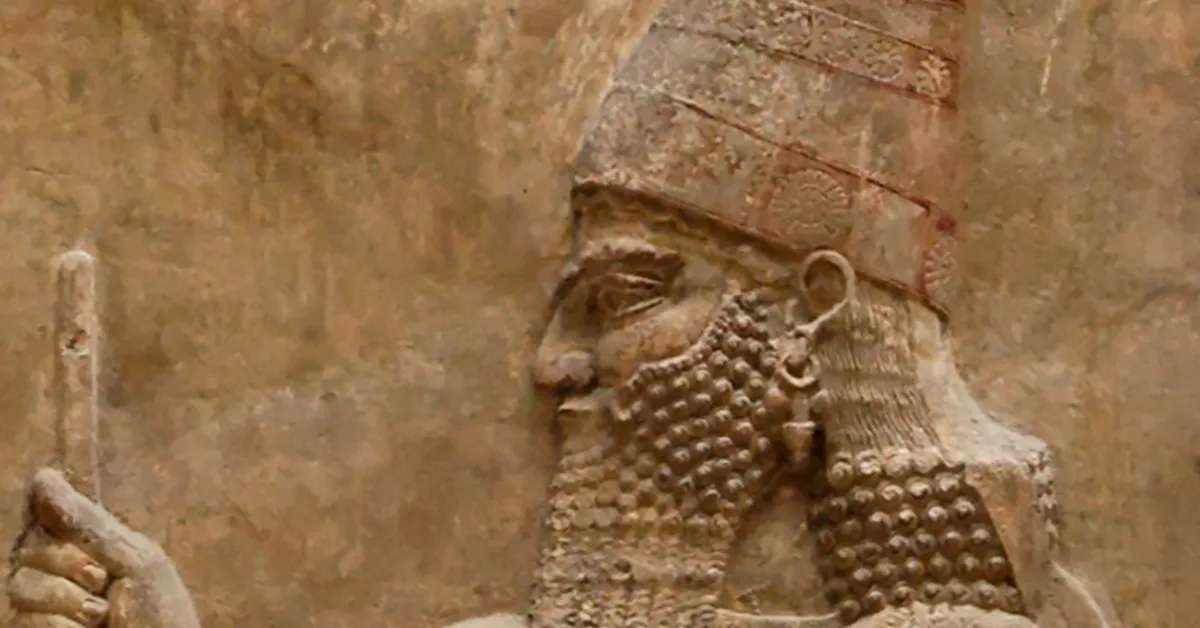
The practice is old enough to predate the man usually blamed for it. The earliest clear instance we have is Assyrian, not Jewish, and not Greek: an inscription of King Sargon II, from between 727 and 707 BCE, records that he built the wall of his city to a length of 16,283 cubits “to correspond with the numerical value of his name.”2 That is a king spending real stone on a pun, a century and a half before Pythagoras was born.
The Greeks ran the same practice through their own alphabet and called it isopsephy. It was not confined to temples or philosophers, either. Scratched on a wall in Pompeii, buried in 79 CE, is a line that needs no scholarship to enjoy: “I love her whose number is 545.”3 Someone had added up the letters of a name and left the sum where the name should go, half love note and half riddle. It is worth holding onto that image, because it tells you what gematria was mostly for: reverence, memory, and play, not forecasting a life.
Gematria in Jewish practice
Gematria’s long home is Jewish tradition, and even there it is worth being exact about the dates. It appears to have entered practice in the Second Temple period, and yet it is absent from the Dead Sea Scrolls, the great cache of texts from roughly 100 BCE to 100 CE, which is a real caution against assuming it was everywhere from the start.2 Systematic use by named rabbis begins with the tannaim in the second century CE, reading number-matches out of scripture as one interpretive tool among many. From there it runs into the Talmud and, later and most famously, into Kabbalah, where the letters of the Torah are treated as a fabric of numbers to be read closely.
The point of this older gematria is worth stating plainly, because it is not the point the modern calculators sell. It was a way of drawing out resonance in a text you already held sacred, a form of commentary. It was never a machine for deciding what a stranger’s name says about them.
Gematria works on the letters, turning a word into a number nobody wrote down. The numbers scripture writes down itself, the forty days and the twelve tribes and the seventh day, are quantities inside a story, and what those came to mean is a related question with a history of its own and its own named commentators.
How it reached modern numerology
The thread from gematria to the numerology you meet online runs through the Latin alphabet. In 1533 the German writer Cornelius Agrippa laid number values across the Latin letters directly,4 and that mapping is the ancestor of the nine-column chart today’s name numbers use. So the method has a long, traceable descent, from Hebrew letters through Greek isopsephy to Agrippa’s Latin table.
What does not have that descent is the reading. Turning a person’s name-number into a portrait of their character has no continuous paper trail before roughly the turn of the twentieth century, and the word numerology in its occult sense is in print by 1907 (the numerology guide has the dates).5 Set the two ages side by side and the gap is stark: gematria has a sourced record running back about 2,700 years; the “what your number says about you” layer is little more than a century old. Most sites on this subject let the older practice lend its age to the younger reading. The two are related by arithmetic and separated by roughly two thousand years, and we would rather tell you which is which.
How to hold it
Ancient gematria is easy to respect once you see what it was doing: finding echoes inside a text its readers loved, or, on a Pompeii wall, flirting in code. The modern habit is different. Feed today’s news through a cipher, try enough systems, and something will always add up. Hebrew alone has several counting methods, standard, ordinal, reduced, and more, and once you are free to pick among them, a match stops being a surprise: with enough methods, almost any two words can be brought to the same total.
This objection is not new, which is worth knowing. The fifth-century philosopher Proclus already made it, arguing that once you allow every way of adding, subtracting, and combining the values, the sheer number of routes lets you reach whatever total you were hoping for.6 That is not a hidden order surfacing. It is the mind doing what it does best, finding patterns, helped along by having many ciphers to choose from until one obliges.
None of which means the arithmetic is worthless to sit with. If a word and its number catch your attention, the honest use is the old one: let it prompt a thought, not settle a question. Add it up yourself, keep track of which cipher you chose, and treat a match as something you noticed rather than something that was decreed. What were you hoping the number would say?
Keep reading
References
- Etymonline: "gematria" Attested in English from the 1680s, through Hebrew from the Greek — the same root that gives us "geometry."
- Encyclopaedia Judaica: "Gematria" The Sargon II inscription (727–707 BCE); gematria's introduction in the Second Temple period; its absence from the Dead Sea Scrolls; the tannaitic examples. Via the Jewish Virtual Library.
- Graffito, Pompeii (CIL IV 4861) c. 79 CE — a Greek isopsephy love note, "I love her whose number is 545." Catalogued in the Corpus Inscriptionum Latinarum, vol. IV.
- Cornelius Agrippa, Three Books of Occult Philosophy Book II (1533; Freake trans., 1651) — number values mapped across the Latin alphabet, the line the modern name systems descend from.
- Etymonline: "numerology" Dates the occult sense "by 1911", a floor and not a first use (the earliest we have found is 1907); the practice it names is far younger than gematria.
- Proclus, On Plato's Cratylus (Duvick trans., 2007) The fifth-century Neoplatonist, following Iamblichus, rejected reading meaning from letter-sums: with enough methods of combining the values, he argued, any number can be produced to suit any purpose.
Cite this page
Numeluna. Gematria, explained. Published . https://numeluna.com/gematria-meaning/