Numerology Chart
The numerology chart, explained
A numerology chart is the small set of numbers worked out from your birth date and your name, laid side by side so you can read them together. That's the short answer. What follows is which numbers make up the chart, where each one comes from, how they fit, and the catch that there's no single canonical chart behind the phrase.
By NumelunaPublished
What a numerology chart is
A numerology chart is the handful of numbers worked out from your birth date and your full name, set down side by side so you can read them as one picture. Most of the weight falls on five of them, the core numbers, and together they’re what people mean when they say “your numerology chart.”
That’s the short answer, and you’re welcome to take it and go. But one thing up front, because almost no page on this subject says it: there is no single mystical diagram behind the phrase. Unlike an astrology birth chart, which really is one generated wheel, a numerology chart is just these numbers gathered in one place. This page is the map of that gathering: what each number reads from, how they fit, and where to go to read each one in full.
The core numbers, and where each comes from
Every core number is made the same way: take something about you, turn it into digits, and reduce until a single digit is left. What changes from one to the next is only the input. Two things about you feed the whole chart, the date you were born and the name you were given, and the five core numbers fan out of them:
Birth date
two numbers
Full name
three numbers
From your birth date · two numbers
Life Path
from your whole birth date
Your core temperament, and the theme that keeps coming back.
Calculate →Birthday
from the day you were born
One specific knack, tied to the date itself.
Calculate →From your full name · three numbers
Expression
also “Destiny”from every letter of your name
Your natural talents, and the shape of what you could grow into.
Calculate →Soul Urge
also “Heart's Desire”from the vowels in your name
What you actually want, underneath the plans you tell people about.
Calculate →Personality
from the consonants in your name
The version of you a room meets first, before it knows the rest.
Calculate →Two of the five come from your birth date: the Life Path, the number the tradition leans on hardest, and the Birthday number, read from the single day of the month. The other three come from your name, split by which letters they count. The Expression uses every letter, the Soul Urge the vowels alone, and the Personality the consonants. Each of those four pages explains its own lens; the Life Path has a page for each of its nine numbers further down.
Every one of them comes down to a single digit the same way. A birth date like 2 June 1991 reduces like this:
2 June 1991
Day2 → 2
MonthJune → 6
Year1991 → 1 + 9 + 9 + 1 = 20 → 2 + 0 = 2
Total2 + 6 + 2 = 10 → 1 + 0 = 1
A Life Path 1. Every core number is worked the same way, just from a different input, so once you have the rule you have the whole chart.
How they fit together
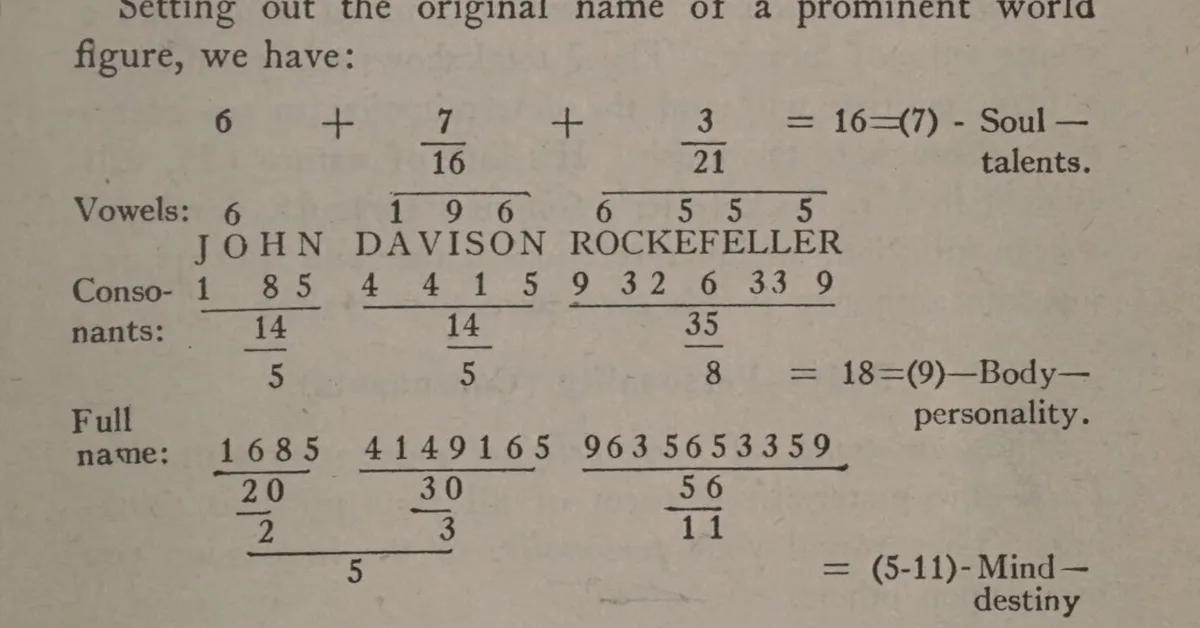
The chart has a shape. The cleanest piece of it is the name three. Because a name is nothing but its vowels and its consonants, and the Soul Urge counts one set while the Personality counts the other, the two sums add straight back up to the Expression. Your inner wants and your outward impression, put together, make the whole name. That’s not a mystical claim; it’s just arithmetic, and you can check it on any name.
The birth-date pair sits a little apart. The Life Path is the through-line of the whole date; the Birthday is one narrower knack read from the day alone. So the chart reads roughly as two accounts of you, one from the date you arrived and one from the name you were called, that a full reading tries to hold in the same frame.
The one rule under all of it, the reducing, is worth learning once. The numerology guide works a birth date all the way down by hand and covers the master numbers: the totals 11, 22, and, for some, 33, which are left standing rather than folded to a single digit.
What each number means
The chart tells you which digit each part of you reduces to. What that digit means is the older, deeper story. The symbolism of one, of five, of nine reaches back thousands of years, long before anyone read it off a birth date. Rather than repeat that history once per core number, we keep it in one place: each digit has a single meaning page tracing it from its earliest legible sense to the reading you’d recognise today.
Keep exploring the numbers
The Life Path is the number most readers come for, so it also has a full write-up per digit: the temperament it’s said to carry, the strengths and the blind spots, and the history behind it:
There is no single canonical chart
Search “numerology chart” and you’ll be offered a “free chart” as though it were one fixed, authoritative artefact. It isn’t. Which numbers belong in a chart is a matter of convention, not of any settled rule. We cover the five that carry most of the reading; a fuller popular chart bolts on a dozen more: maturity, balance, karmic-debt and karmic-lesson numbers, and a whole forecasting layer of pinnacles and personal years. Different practitioners include different ones. The chart is a bundle, and the bundle’s edges are drawn by taste.
The disagreement runs deeper than which numbers to include. For the three name numbers there is not even one agreed way to turn letters into digits. The common Western method is the Pythagorean, the nine-column chart that runs A to I as 1 to 9 and then wraps around. A second tradition, usually called Chaldean, assigns the letters differently and keeps 9 aside as sacred, so the same name can reduce to a different number depending on which one you follow. We use the Pythagorean throughout, because it’s the one nearly all modern English-language numerology uses. Neither is the “true” chart. They are conventions, and a number means only what you and the system agree it means.
The pieces of a chart are not the same age. Turning letters into numbers is ancient: gematria is attested in an Assyrian inscription from the 8th century BCE,1 and the symbolism of the digits themselves was set down by the Greeks. The surviving Theology of Arithmetic explains why four reads as justice and seven as “the virgin.”2 In 1533 Cornelius Agrippa mapped number values across the Latin alphabet, the direct ancestor of the chart the name numbers use.3
The idea of reading those numbers as a person, and gathering them into a single character profile, is far younger. It belongs to early-1900s American New Thought; the writer most often credited is L. Dow Balliett, whose books of 1905 and 1908 reworked the old symbols into traits and treated a name’s numbers as a reading of character rather than a forecast.4 The word numerology itself is younger still, its occult sense in print by 1907.5 The numerology guide traces the dates. So the arithmetic is old and the “chart about you” is about 120 years old, and the tidy diagram you half-picture when you hear the phrase was never really there. Knowing that is not a reason to put the chart down. It’s a reason to read it with your eyes open.
Reading your chart as one picture
Read together, the core numbers are better used as a mirror than a machine. No number here caused anything about you, and the chart won’t tell you what happens on Tuesday. What it’s good for is recognition: five angles on the same person, which now and then line up in a way that’s useful to notice: the through-line of your Life Path sitting next to what your Soul Urge says you want.
So the honest way to read a chart is the same as reading any one number. Work the arithmetic yourself, read where each digit’s meaning came from, and keep whatever helps you see yourself a little more clearly. The parts that land are worth sitting with; the rest you’re free to leave. And if the whole exercise has you wondering whether numerology is real, that question is worth asking out loud — the chart is a lens, not a forecast. Which of your numbers were you hoping to find here first?
Your whole chart
See how your numbers read together
Your five core numbers are only the start. A full reading reads them together, then goes where a single calculator can't: your four pinnacles and four challenges, the personal year you're in now with the dates it opens and closes, and where your name leans hardest and where it stays silent. One woven reading, with every step shown.
- A private reveal you return to, and can share, a link that opens for someone else too.
- A keepsake PDF, your whole reading set like a page to keep.
- A print-ready PDF, a copy you can hold.
If you buy the reading and it reads like the free numbers padded, write to us within 30 days for a full refund.
Keep reading
References
- Gematria: the Sargon II inscription (727–707 BCE) The earliest attested letter-as-number practice, Assyrian rather than Jewish; documented in the Encyclopaedia Judaica.
- Iamblichus (attrib.), The Theology of Arithmetic (Waterfield trans., 1988) — the fullest surviving ancient work on number symbolism; four as justice, seven as "the virgin."
- Cornelius Agrippa, Three Books of Occult Philosophy Book II (1533; Freake trans., 1651) — number values mapped across the Latin alphabet, the ancestor of the Pythagorean chart.
- L. Dow Balliett, The Philosophy of Numbers: Their Tone and Colors (1908; 5th ed. 1917) — the New Thought reworking of number symbolism into character, and the root of gathering a person's numbers into a single reading.
- Etymonline: "numerology" Dates the word's occult sense "by 1911", a floor and not a first use (the earliest we have found is 1907); the practice it names is older than the name.
Cite this page
Numeluna. The numerology chart, explained. Published . https://numeluna.com/numerology-chart/