Numerology, honestly
Is numerology real?
Yes and no — and the answer turns on what you are asking numerology to be. As a window into the future, that's a matter of faith. As a prompt for self-reflection, there's real research that says it may be beneficial under the right circumstances. As a hobby, a way of being entertained by the universe and its strange patterns: very real. As a cultural phenomenon, it's a century-old movement standing on a much older tradition of number-meaning, and roughly 3 in 10 American adults touch some version of it in a year.
By NumelunaPublished
What you're asking when you ask
Most people arrive at this question in a particular kind of week. Things aren’t going like you planned, or a decision is sitting there refusing to make itself, or a number has caught your attention three times in four days and you’d like to know whether that means anything. Some people arrive for a happier reason: the mysticism is fun, the patterns are strange, and it’s entertaining to poke at them.
Let’s consider the question again.
Does a birth date exert some force on a life? Nobody has proposed a mechanism for how it would. And the few times anyone has looked for a correlation, nothing turned up. One test took every Nobel laureate from 1901 to 2010, worked out each one’s birth number the way a numerologist would, and looked at whether the numbers said to mark exceptional achievement were over-represented among them. They weren’t. The distribution sat where chance would put it.1 Whether that settles it for you is between you and what you believe.
Does something genuine happen when a person uses numerology? Yes, though nearly all the research is on tarot rather than numerology. People who use these tools reflectively tend to report the same thing: they arrive not at answers, but at insight into their lives and selves. The catch: when psychologists sorted self-reflection into its parts, the part that predicted well-being was insight, where something lands and you can act on it. Reflection without insight is rumination, and it predicted well-being in the other direction.2
Is it a good way to spend an evening? Oh, yes. Arithmetic that hands back a sentence about you is a pleasant machine, and finding the universe interesting is a beautiful thing.
And is it a real cultural phenomenon? That one isn’t close. The habit of reading meaning into number is roughly twenty-four centuries old. The specific practice of reading your character off your name and birthday is about a hundred and twenty. Both are still running.
What a reading actually is
Underneath every system, the machinery is the same.
You start with a couple of fixed inputs: your full birth name, your birth date, sometimes only the digits of a year or only the vowels in your name. Each one runs through a single move. Add the digits up, keep adding until one digit is left, and stop early on 11, 22 or 33, which the tradition calls master numbers. Then read the result against a fixed table of interpretations.
Birth date
two numbers
Full name
three numbers
From your birth date · two numbers
Life Path
from your whole birth date
Your core temperament, and the theme that keeps coming back.
Calculate →Birthday
from the day you were born
One specific knack, tied to the date itself.
Calculate →From your full name · three numbers
Expression
also “Destiny”from every letter of your name
Your natural talents, and the shape of what you could grow into.
Calculate →Soul Urge
also “Heart's Desire”from the vowels in your name
What you actually want, underneath the plans you tell people about.
Calculate →Personality
from the consonants in your name
The version of you a room meets first, before it knows the rest.
Calculate →What separates one calculation from another isn’t the arithmetic. It’s which input you feed it and which question that input answers: birth date for your life path, full name for how you express yourself, the vowels in your name for what you want deep inside. One reduction, several lenses, all trained on the same handful of digits.
Which means everything interesting happens at the last step, the moment a person meets a number and decides what it says about them. The arithmetic is not in dispute. It will hand you the same digit every time, and you can check it on paper. The argument is entirely about what happens next.
As a mirror: what the evidence supports
Start with how people actually use this, because the assumption baked into the question is mostly wrong.
When Pew surveyed 9,593 American adults in late 2024, about 30% said they consult astrology, tarot or a fortune teller at least once a year. That headline travelled widely. The breakdown underneath it didn’t.3
- 70 consult none of the three
- 20 consult one, mostly for fun
- 10 consult one, believing it gives them helpful insights
And 1 of those hundred relies on it a lot when making a major life decision.
Source: Pew Research Center, survey of 9,593 US adults, October 2024.
| consult none of the three | 70% |
|---|---|
| consult one, mostly for fun | 20% |
| consult one, believing it gives them helpful insights | 10% |
| Rely on it a lot for major life decisions | 1% |
One in a hundred! The picture of a population outsourcing its choices to the stars turns out to describe almost nobody, and twice as many people are in it for fun as for guidance. Most people already hold these things loosely; no need, for example, to feel sheepish about having a favourite number.
Why reach for it at all, then, and why more in bad seasons? Jennifer Whitson and Adam Galinsky ran six experiments on this and found that reducing a person’s sense of control makes them see patterns that aren’t there: images in visual noise, correlations in stock data, conspiracies in unrelated events.4 The mind reaches for order when it feels unsteady. They also found that affirming the self reduces the effect; steadying somebody quiets the search.
That lines up with what the few studies of reflective use have found. Gigi Hofer interviewed four women who use tarot regularly and specifically not as divination, and reported that they used the cards to get at insight into a current situation and possible plans of action, and that they reached for them most in difficult times, when the cards offered comfort.5
Seventeen years later, a team of researchers interviewed twelve tarot readers who had begun using AI in their practice and found the same posture in a very different setting: they wanted alternative interpretive lenses that might surface their own blind spots, not answers, and most of them worked out what a spread meant themselves before asking the machine what it meant.6 One reader, twenty years into the practice, described the rule they had made for themselves:
It could be really easy just to go ask [the AI]. … You’re not going to have the subconscious moment where you’re intuiting the experience yourself. … When I do use it, I make the interpretation myself before I go ask for it.
Nobody imposed that. The people furthest into the practice were the ones most careful to keep the interpreting in their own hands.
Both studies are small, self-selected, and about tarot rather than numerology. Take them as a description of how reflective users describe the practice, not as proof it beats a good question or a notebook.
Consider that carefully, because “it’s a tool for self-reflection” gets said about numerology constantly, as though reflection were self-evidently good for you. The research is fussier than that. Rick Harrington and Donald Loffredo measured self-reflection, insight and rumination against six dimensions of psychological well-being and against life satisfaction. Insight, the part where you actually make sense of what you noticed, predicted all six and life satisfaction too. Self-reflection on its own predicted close to nothing. Rumination, the circling that never resolves, predicted well-being negatively.2
So the defensible claim is: a prompt is worth something when it gets you to an insight you can do something with. The same prompt, reread at midnight for reassurance, is the shape of the thing the rumination research warns about. The tool isn’t the active ingredient. You are.
As an oracle: is numerology accurate?
Now the narrow scientific question: does a birth-date sum predict anything about a person?
The best-documented answer starts somewhere unexpected. In 1949, the psychologist Bertram Forer gave 39 students a personality test and handed each of them a written sketch with their own name on it. Every sketch was identical. Asked how well it captured them, the students rated it 4.26 out of 5. Forer put the detail that matters in a footnote: he had assembled the statements from a newsstand astrology book.7 They read like this:
You have a great need for other people to like and admire you. … At times you are extroverted, affable, sociable, while at other times you are introverted, wary, reserved.
This is the Barnum effect. Vague, mostly flattering, two-sided statements feel personally true to nearly everyone, because nearly everyone can find a week when each half fit. Add confirmation bias, where we keep the lines that landed and quietly lose the ones that missed, and a reading that resonates starts to feel like evidence.
The consequence is clean, and it applies to numerology as much as to horoscopes: resonance is exactly what you’d expect from random text. So a profile feeling uncannily accurate can’t, on its own, be evidence that the system works.
Then there are the direct tests. The Nobel study is the first.1 The second is more pointed, because it was run by people who wanted to find something. In 1993, a researcher for the Association for the Scientific Study of Anomalous Phenomena surveyed 96 of the association’s own members, an audience already sympathetic to psychic and paranormal claims, to test a specific numerological claim: that the number 7 marks someone psychically aware.8
The most obvious point is that the number 7 does not stand out in the results where it should do. … 5 would a better bet than 7!
A friendly sample, a specific claim, and nothing there. Inside science, the word numerology has meanwhile become an insult, the term researchers reach for when a theory leans on pattern-matching instead of observation; as the mathematician I. J. Good put it, a number pattern is worth something only when a real theory explains it.9
You can see that missing theory in the systems themselves: the Pythagorean chart and the older Chaldean one give the same letters different numbers, so a name reduces one way or the other depending on which you happen to use, and neither offers a reason to be the right one.
Here’s the thing: numerology specifically is barely studied. Those two direct tests are the exceptions; nearly all the rest of the literature is on astrology, tarot and paranormal belief in general, with numerology folded in or skipped. Pew surveyed nearly ten thousand Americans about divination and didn’t break numerology out as its own category. So when anyone, this page included, says “the evidence,” they’re mostly reasoning across from the neighbours. It also fits the shape of the thing: the word numerology in its occult sense is in print by 1907 (the numerology guide has the dates),10 a young practice wearing an old face.
None of it makes the older tradition worthless either. The study of what numbers mean, arithmology, is about 2,400 years old, and the habit of taking number seriously runs through the history of mathematics and astronomy both. What’s young, and unevidenced, is the particular modern move of reading your character off your name or birthday. The Pythagoras page traces that join in full.
Why both of those can be true
The two sections above look like they contradict each other. A reading is vague enough that identical text scores 4.26 out of 5, and also a usable prompt for reflection. Both of those are true at the same time.
The CHI researchers reached for Hartmut Rosa’s work on resonance to explain what their practitioners kept describing. Their finding was that the randomness is doing the work: it introduces contingency, which creates space for unexpected perspectives, and it removes determinism while still supporting the reader’s interpretive authority.6 An idea that arrives from outside you feels authorised in a way that a thought you simply had about yourself does not.
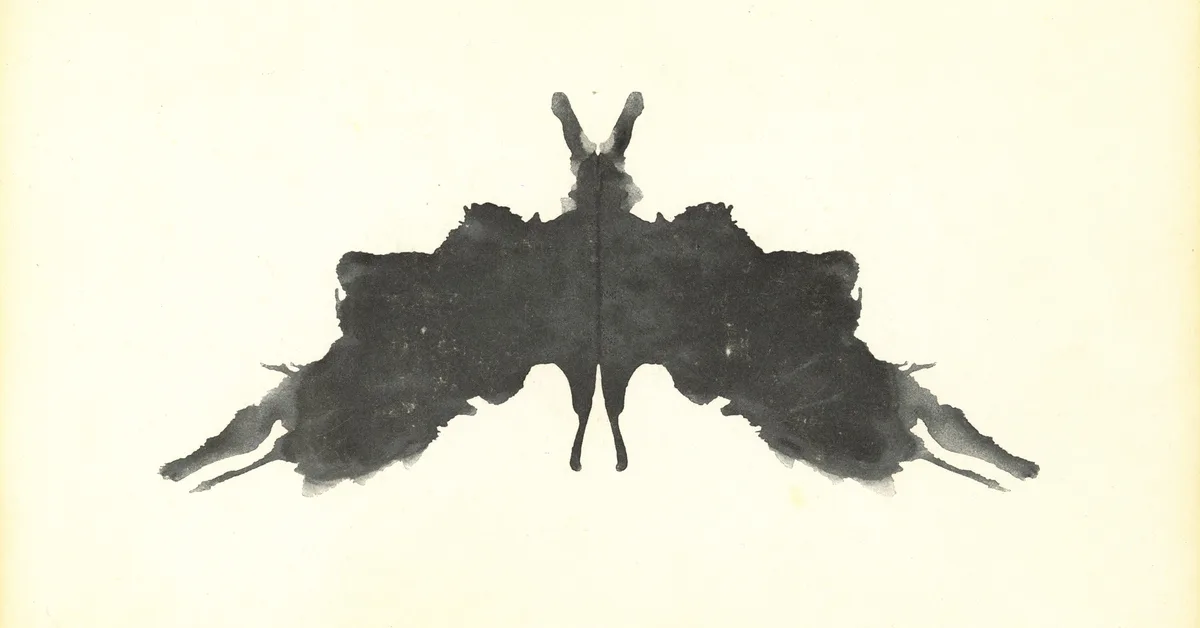
Which is the Rorschach point, arriving from a different direction. The inkblot has no content. That’s the feature. A shape specific enough to mean one thing would give you nothing to project onto, and it’s the projection that carries the information, because it’s yours.
So the vagueness that makes a numerology reading a questionable oracle is the same property that makes it a workable surface to think against. One trait, two verdicts, depending on what you asked it for. This doesn’t rescue the predictive claim. It explains why the reflective use survives knowing the predictive claim is empty, and why people who understand the Barnum effect perfectly well still keep a deck in the drawer.
How far back this actually goes
Whatever you make of the evidence, none of this appeared last year. The symbolism is old and traceable. The personality reading built on top of it is recent and datable. Keeping the two apart is most of what separates a sourced account from a sales pitch.
- 6th c. BCE
The Pythagoreans
A Greek school treats number as the key to cosmic order. No writings survive, so everything “Pythagoras taught” is later reconstruction, not his own words.
- c. 100 CE
Nicomachus of Gerasa
His Introduction to Arithmetic becomes the standard Greek handbook of number theory, the arithmetic that later number symbolism sits on.
- 2nd–4th c. CE
The Theology of Arithmetic
The longest surviving ancient work on number symbolism, attributed to Iamblichus and compiled from Nicomachus and Anatolius. It is our fullest source for what each number was said to mean.
- c. 500 CE
Boethius
Renders the Greek number theory into Latin, the pipe through which it reached medieval Europe and stayed standard curriculum for roughly a thousand years.
- 1533
Cornelius Agrippa
Occult Philosophy, Book II systematizes each number’s “virtue” and maps values onto the alphabet, a bridge from cosmic symbolism toward letter-based numerology.
- late 1800s
The occult revival
Theosophy and popular showmen like Cheiro turn number divination into mass entertainment; the letter-number systems consolidate.
- 1905–1917
Balliett, the personality turn
American New Thought writer L. Dow Balliett reads a name, its vowels and a birth date together as character, from How to Attain Success Through the Strength of Vibration (1905) on. It is the earliest text we have found that does all of it.
- 1970s–90s
Mass-market profiles
Books like Javane & Bunker (1979) and Dan Millman (1990) codify the per-number personality profiles now standard across the web.
Read down that column and the shape is clear enough. Twenty-four centuries of people arguing about what a number means, and then, quite late, an American New Thought writer turning that inherited symbolism into a description of your personality. Numerology itself is about as old as the crossword, but the tradition behind it is ancient.
How many people are actually doing this
The Pew survey gives the firmest count: 30% of US adults consult astrology, tarot or a fortune teller at least once a year, 14% monthly, 6% weekly. Belief that the position of the stars and planets affects people’s lives sits at 27%.3
That last figure was 29% in 2017. Which is to say: after a decade of astrology apps, birth-chart discourse and an entire aesthetic economy, measured belief has not moved. What grew was the visibility and the commerce, not the conviction.
Numerology is the smaller sibling throughout, and Pew didn’t break it out as its own category, so no national figure for it exists. The full breakdown, who the practice concentrates in, and our own dated counts of the online communities are on how many people believe in astrology and numerology.
Surveys measure what people say. One body of evidence measures what they do instead: across East Asia, avoiding the number four and paying up for eight moves real prices, in licence-plate auctions and in housing, by margins economists have put a figure on. That is not evidence that the numbers work. It is evidence that the belief is common enough, and firm enough, to show up in a market. The figures are on what an unlucky number costs.
All of this is just evidence that a great many people, over a very long stretch of time, have found something here worth coming back to. That’s a real thing about the world, whatever you decide about the rest.
How to hold it
So: is numerology real?
The way to hold it, if you want one: as a lens, not a forecast. Something you argue with rather than obey. Work your own number out by hand, which takes about a minute, then read what the older tradition made of it, whether that’s Pythagorean symbolism or the letter-values of gematria, and notice what it stirs up in you. The chart will hand you the same digits every time; the arithmetic is honest and checkable, and that’s the one part of this nobody disputes. What it means is the part you supply.
Enjoy the pattern. Don’t hand it the wheel.
Keep exploring the numbers
Keep reading
References
- "A Test of Numerology: Do Birth Numbers Predict Nobel Prize Winners?" (J. Articles in Support of the Null Hypothesis, 2017) One of the rare direct tests of numerology rather than astrology: the birth numbers of every Nobel laureate from 1901 to 2010 showed no significant deviation from chance.
- Rick Harrington and Donald A. Loffredo, "Insight, Rumination, and Self-Reflection as Predictors of Well-Being," The Journal of Psychology 145(1) (2011) Insight predicted all six dimensions of psychological well-being and life satisfaction. Self-reflection on its own predicted almost nothing, and rumination predicted well-being negatively.
- Pew Research Center, "30% of Americans Consult Astrology, Tarot Cards or Fortune Tellers" (2025) Chip Rotolo, published 21 May 2025; fieldwork October 2024, 9,593 respondents. The source for the 30% figure and, more usefully, for the breakdown: 20% consult mostly for fun against 10% for helpful insights, and 1% rely on it a lot for major decisions.
- "Lacking Control Increases Illusory Pattern Perception," Science 322 (2008) Jennifer Whitson and Adam Galinsky. Six experiments: reducing a person's sense of control makes them see patterns in noise. Self-affirmation reduces the effect.
- Gigi Michelle Hofer, "Tarot Cards: An Investigation of their Benefit as a Tool for Self Reflection" (MA thesis, University of Victoria, 2009) Interviews with four regular users who use the cards reflectively rather than for divination. Small and self-selected, and one of the few studies to look at the reflective use directly.
- Matthew Kieran Prock and colleagues, "Interpretive Cultures: Resonance, randomness, and negotiated meaning for AI-assisted tarot divination," CHI '26 Twelve tarot practitioners interviewed. Finds that randomness introduces contingency that creates space for unexpected perspectives, and that readers interpret a spread themselves before asking anything else.
- Bertram R. Forer, "The Fallacy of Personal Validation" (J. Abnormal & Social Psychology, 1949) The founding study of the Barnum effect: 39 students rated an identical, astrology-book-sourced personality sketch 4.26 out of 5 as uniquely their own.
- Maurice Townsend, Association for the Scientific Study of Anomalous Phenomena, member survey (1993) A second direct test, of a different claim: that the number 7 marks someone psychically aware. Surveyed 96 of the association's own members, people already inclined toward psychic interests. The number 7 did not stand out.
- Wikipedia: "Numerology" On the scientific use of "numerology" as a pejorative for pattern-matching over observation, and I. J. Good's principle that a number pattern counts only when a real theory explains it.
- Etymonline: "numerology" Dates the occult sense of the word "by 1911", a floor and not a first use (the earliest we have found is 1907), young for a practice that borrows a 2,500-year-old face.
Cite this page
Numeluna. Is numerology real? Published . https://numeluna.com/is-numerology-real/