Number superstition
Tetraphobia: the number the world builds around
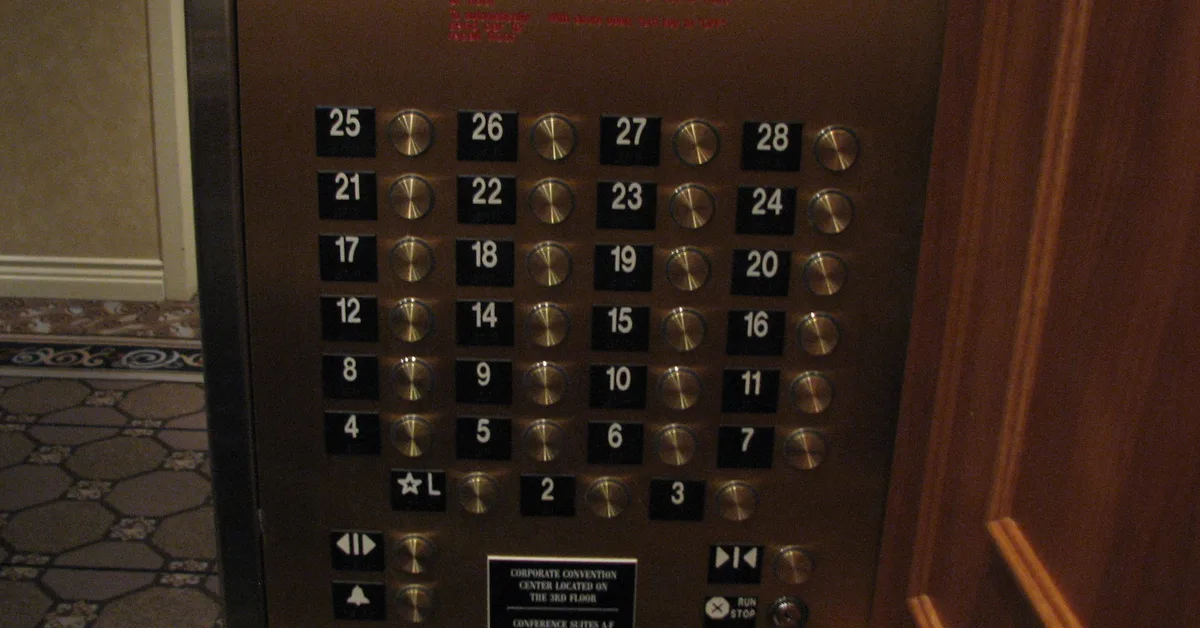
Tetraphobia is the avoidance of the number four, and across East Asia it's common enough to redraw an elevator panel. Nothing about four reaches out and does anything — the word simply sounds like the word for death — but the belief is real enough that economists have gone looking for what it costs, and found it in licence plates, in house prices, and in the floors that buildings pretend not to have.
By NumelunaPublished


The floor that isn't there
In elevators across much of East Asia, the buttons run 1, 2, 3, 5. At the Wynn in Las Vegas, the omissions run further still: no fourth floor, and nothing at all between the thirty-ninth and the fiftieth. Vancouver has residential towers that skip every number with a four in it.1 Across the English-speaking world, you’ll find buildings where the twelfth floor is followed by the fourteenth.
Now count the landings. For sure, whoever lives above the third floor opens their door onto the same view they’d have had if the button said 4. Nothing was built or demolished. Eradicating a floor is just a matter of labelling; this particular instance of number-superstition costs nobody anything.
That this phenomenon exists doesn’t, in and of itself, prove that large swathes of the world’s population believe in superstition. But these buildings do tell you that somebody decided it was cheaper to skip a level than to argue about it.
Why four is unlucky in China, Japan and Korea — and what travelled without the sound
Say the Mandarin word for four out loud: 四, sì. Now say the word for death: 死, sǐ. What separates them is a tone, a small shift in pitch across a syllable that’s otherwise the same syllable.2 In Japanese and in Korean, even that much is gone. Four is shi and death is shi; four is sa and death is sa.


That’s the engine. Four is the unlucky number across much of East and Southeast Asia — in China, in Japan, in Korea — because you can’t say it without very nearly saying death. Nothing about four itself is at issue: not its evenness, not its squareness, not the four directions or the four seasons or the four humours that so occupied the Greeks. A sound collided with another sound and morphed into a cultural association.
Japanese has a way around it. The language runs two sets of number words, one borrowed from Chinese and one native, so four can be said as shi or as yon. It’s yon you’ll usually hear when someone counts out loud.
But the avoidance runs further than conversation. When Saskatchewan, Canada, ran short of telephone numbers, the committee planning its second area code had 474 available and asked the regulator for 639 instead.
There were some negative connotations with 474.
That was SaskTel’s spokesperson. The reporter supplied what she was pointing at: four is considered bad luck in Chinese culture.
The pun can tell you where the superstition began, but how far has it spread? This one crossed an ocean into cities where the words for four and death have never once been confused, and was incorporated into buildings raised by developers who couldn’t tell you what 死 sounds like.
So the sound of these words — the foundation of this superstition in China, Japan and Korea — didn’t travel into English, but a slice of culture did: the expectation that some buyer, some tenant, some guest will mind. What the taboo’s strength seems to follow is where the communities that hold it have settled, rather than any feature of the local language.
There’s a word for all of this, assembled out of Greek: tetraphobia, from tetra, four, and phobos, fear. It belongs to a family of such coinages, most of them built by lexicographers rather than clinicians.
Why do four and death sound alike in three different languages?aside
Not a coincidence, and not three separate accidents. In Middle Chinese, the ancestor of today’s Chinese varieties, the two words were already near-twins: the same consonant and the same vowel, separated only by tone.2
Japanese and Korean borrowed their number words from Chinese wholesale, somewhere between the fifth and ninth centuries, and neither language had tones to borrow them with. The one distinction holding the two words apart didn’t survive the crossing. What arrived was a single sound doing both jobs.
Vietnamese borrowed the same vocabulary and kept its tones, so tứ and tử stayed apart.
Eight, the lucky number — and the question everyone actually asks
Four has a counterpart. Eight is the lucky number, and it sprang from the same machinery in reverse: 八, bā, sits a shade away from 发, fā: to prosper, to make a fortune.1 The same accident of sound, the same absence of any reason belonging to the number itself, and the opposite verdict.
Different numbers rhyme differently in Cantonese; but there is a universal consensus in Hong Kong that “8” is good and “4” is bad.
China put it on display at the largest scale available. The Beijing Olympics opened at eight minutes and eight seconds past eight in the evening, on the eighth day of the eighth month of 2008 — a run of eights assembled for a ceremony in which nothing else had been left to chance, either.1
There’s no word for this one. The lexicographers who assembled tetraphobia out of Greek never got round to its opposite: there’s no coinage, in any dictionary you can check, for the person who wants the eight. The fear was named. The preference — the half that leaves receipts — was not.
Set the elevator panels and the ceremonies aside. The question that gets typed into search boxes is blunter than any of it: does the number eight attract money?
As far as we know, nothing about the number 8 reaches out into the world and tilts a fortune toward whoever picks it, much like we don’t expect the number 4 to bring you bad luck. In fact, according to economists, eight doesn’t attract money — it costs money.
Where enough people want the number, the number itself becomes expensive — a licence plate with an eight in it, a house with an eight in the address.
What the number is worth
Let’s start where the market is cleanest. Hong Kong auctions its licence plates in public and publishes what they sell for, which is how a superstition ends up being measured. Ng, Chong and Du, three economists at the Chinese University of Hong Kong, worked through 41,069 plates sold across 292 auctions between 1997 and 2009.
Controlling for other factors, an ordinary 4-digit plate with one extra “8” on average was sold at 63.5% higher, while an ordinary 4-digit plate with one extra “4” on average was sold at 11% lower (both relative to the number “7”).
Houses are slower and messier than plates, and the effect shrinks to match. Fortin, Hill and Huang, economists at the University of British Columbia, took in about 117,000 Greater Vancouver sales between 2000 and 2005. An address ending in eight sold for 2.5% more, one ending in four for 2.2% less — but only in neighbourhoods where more than 18% of residents were Chinese.1 Region-wide there’s nothing to find. The premium sits precisely where the people who carry the convention sit.
The oldest study is still the tidiest. Steven Bourassa and Vincent Peng, working from the University of Louisville in Kentucky, took 2,164 detached-house sales across two adjacent Auckland suburbs between 1989 and 1996: under five square kilometres, similar houses, similar households, which leaves very little besides the number on the door to explain a gap in price. Houses whose address ended in 3, 6, 8 or 9 sold for about 2.4% more: some NZ$7,100 against a mean price of NZ$293,200.5
Then they ran the same test on a comparable patch nearby — same city, same sort of houses, same distance from town — where few Chinese residents lived. If the premium were really coming from something else, from wider streets or larger sections or any of the hundred things a house number might quietly stand in for, it should have shown up there too. It didn’t. The only thing that had changed was who lived there.
The claim
A number with an eight in it sells for more.
What it asked: If a digit that sounds like prosperity is genuinely worth money, then two otherwise identical things — two plates in the same auction, two houses on the same street — should part on price by the digit alone.
1999Bourassa & PengFound it
2,164 detached-house sales across two adjacent Auckland suburbs, 1989–1996: under five square kilometres, similar houses, similar households. Addresses ending 3, 6, 8 or 9 sold for about 2.4% more — some NZ$7,100 against a mean of NZ$293,200. Run again on a comparable patch nearby with few Chinese residents, the premium is absent.
β = 0.0119 [SE 0.0064], p = 0.0632010Ng, Chong & Du✓Held
41,069 Hong Kong licence plates across 292 auctions. An extra 8 carried +63.5% on an ordinary 4-digit plate and +94.8% on a 3-digit one — the largest effect anyone has measured, in the cleanest market anyone has found.
β = 0.635 / 0.948 on ln(price)2014Fortin, Hill & Huang✓Held
About 117,000 Greater Vancouver sales, 2000–2005. An address ending in 8 sold for 2.5% more — but only in census tracts where ethnic Chinese residents exceed the regional average of 18%. Region-wide there's nothing to find.
Holds in all three markets
The only claim on this page that reproduces everywhere anyone has looked for it. And in each market it appears exactly where the people who carry the convention are, rather than across the market as a whole — which is the finding, not a caveat on it.
The ladder has nine rungs, not two
Every article on the subject teaches the same two facts: four is bad, eight is good. But the auction data has all ten digits in it, and the ladder runs a good deal longer than anyone reports.
Eight sits alone at the top. Then a tight band of three, one, two and six; then nine, then zero, then seven. At the bottom, four — and five.
Figure 3.What each digit was worth at auction
Every extra occurrence of a digit in an ordinary 4-digit plate, as a percentage against the digit 7 — the category the authors left out, so every bar here is measured from it.
Ng, Chong & Du 2010 · 41,069 Hong Kong plates across 292 auctions, 1997–2009 · figures are the published log coefficients ×100, not exact price effects
cheaper than a 7dearer than a 7
Table view — all ten digits, both plate lengths
| Digit | 4-digit plate | 3-digit plate |
|---|---|---|
| 8 | +63.5% | +94.8% |
| 1 | +33.2% | +46.9% |
| 3 | +32.5% | +55.4% |
| 2 | +32.1% | +42.7% |
| 6 | +29.2% | +36.5% |
| 9 | +21.5% | +29.4% |
| 0 | +12.4% | +30.0% |
| 7 | baseline | baseline |
| 4 | −11.0% | −27.3% |
| 5 | −12.5% | −19.5% |
Five is the surprise. It’s discounted about as heavily as four is: roughly 12% against four’s 11% on the four-digit plates, and on the three-digit plates the two swap places. It sits in the same table, drawn from the same auctions, significant in every column the authors ran — and they never mention it. The word five does not appear anywhere in their paper.4
One caution before carrying that anywhere. This is Hong Kong. The Auckland study counted five among its lucky digits in combination — the opposite verdict, in a different market, and nobody has reconciled the two.5
Is numerology 4 bad luck?aside
No, and the two systems have nothing to do with one another. Western numerology reaches its meanings by reasoning about what a number is: four is the square, the four directions, the four seasons, and so it arrives at solidity and structure — which is roughly the opposite of a death omen. The Chinese four arrives where it does because of how the word sounds, and by no other route. One tradition argues from the number, the other from the noise it makes. If you want the Western readings, they’re at number 4 and number 8.
The claim
A number with a four in it sells for less.
What it asked: The mirror of the eight. If the sound of death is worth something, it should be worth something negative — and it should turn up on the same evidence, in the same places.
1999Bourassa & Peng✕Didn’t hold
The same 2,164 Auckland sales that turned up the premium. Tested for a four discount, and found nothing that reached significance.
β = −0.0171 [SE 0.0114], p = 0.1342010Ng, Chong & DuFound it
−11% on ordinary 4-digit Hong Kong plates, −27.3% on 3-digit ones. Large, and significant in every column the authors ran.
β = −0.110 / −0.273 on ln(price)2014Fortin, Hill & Huang✓Held
−2.2% on Vancouver addresses ending in four, under the same 18% conditioning as the eight. Agrees with Hong Kong in sign, and at roughly the size a housing market rather than an auction would predict.
Holds in two markets of three
The lucky eight reproduces everywhere it has been looked for. Its unlucky twin does not — it's missing from the one market that looked for it first, and nobody has gone back to Auckland to settle it.
Reading this one. The Auckland null is the most-dropped fact in this literature, and it's also too small to carry the weight people put on it. Its interval is consistent with a discount larger than the premium the same paper reports, so it means the effect is not established there — never that it was shown to be zero.
Meanwhile, in the West
The West has its own missing floor, its own unlucky number, and its own Greek coinage for it — triskaidekaphobia, built the same way and no more clinical. Thirteen is older than the four, and its origins are harder to pin down.
Tok Thompson, an anthropologist at USC, went looking for where it came from and found the same association in traditions with no obvious route between them: early Europe, the Aztec world, several Native North American peoples, pre-Buddhist Tibet. His explanation is a calendar. A year holds about 12.41 lunar months — more than twelve, fewer than thirteen — so any culture keeping time by both the sun and the moon is left with an awkward, irregular thirteenth month to dispose of. Thirteen is the leftover. He offers this as a hypothesis rather than a finding.6
If he’s right, the two taboos on this page were built by opposite methods. Four is an accident of sound that then travelled with the people who made it. Thirteen was stumbled upon separately, several times over, by people looking at the same sky. Neither has anything to do with the numbers.
And like any convention, it drifts. In Greece, Spain and Mexico the unlucky day is Tuesday the thirteenth rather than Friday.7 In Italy the unlucky number is a different one altogether — seventeen, and the date to be wary of is Friday the seventeenth.8
What are all these words?aside
Two of them are real words. Tetraphobia and triskaidekaphobia — four-fear and thirteen-fear — both have entries in the Cambridge dictionary910, which defines the second one not as a phobia at all but as a superstition. It records a plainer variant of the first, too: quadrophobia.
The rest circulate without ever having been let in. Paraskevidekatriaphobia and friggatriskaidekaphobia both mean fear of Friday the thirteenth, the second built on Frigg, the Norse goddess whose day Friday is. Hexakosioihexekontahexaphobia is fear of 666, and Collins holds it only as a reader’s suggestion rather than an entry.
Six names for the fear, then, two of which a lexicographer has signed off on. For the other side — the belief that a number will bring you money — there’s nothing at all.
In 2007, Gallup asked a thousand Americans how much it would bother them to be given a hotel room on the thirteenth floor. Eighty-seven per cent said it wouldn’t. Thirteen per cent said it would, a figure Gallup reported with some visible pleasure. And of those, nearly three-quarters said they would ask to be moved — nine per cent of everyone asked, willing to trouble a stranger at a front desk over a number.11
What thirteen is worth: nothing
So somebody went and looked. James Larsen, a finance professor at Wright State University in Dayton, took 3,701 single-family house sales in his own Montgomery County, Ohio, and asked what a thirteen in the address was worth.7
Nothing at all. Not a small effect, not a suggestive one — nothing. He widened it to more than eighty thousand sales, counting a thirteen anywhere in the house number, and got the same nothing.
Then he did the thing that makes the paper worth reading. He ran the identical test on every other house number — ninety-eight more times. Seven came back with a price effect: 7, 25, 27, 34, 40, 54 and 59. Nobody has ever thought 27 lucky. Nobody crosses the street to avoid 54. Larsen’s own conclusion is that all seven are coincidence — roughly the crop you would expect from running the same test a hundred times over.
The claim
A thirteen in a Western address makes the property cost less.
What it asked: The West has its own unlucky number and its own Greek coinage for fearing it. If the Chinese four turns up in a price, thirteen ought to as well.
2014Fortin, Hill & HuangᴿFound it
−2.8% on comparable Vancouver properties. Reported through Larsen's summary of the paper rather than read in the original, so treat it as the weakest entry here.
2015Larsen✕Didn’t hold
3,701 single-family sales in Montgomery County, Ohio — a study designed for this question and powered to answer it. Nothing at all: not a small effect, not a suggestive one.
β = 0.00785 [SE 0.08784], t = 0.09, p = 0.9292015Larsen✕Didn’t hold
Widened to more than eighty thousand sales, counting a thirteen anywhere in the house number rather than only at the end. The same nothing.
The control. Larsen then ran the identical test on every other house number — ninety-eight more times. Seven came back significant: 7, 25, 27, 34, 40, 54 and 59. Nobody has ever thought 27 lucky. His own verdict is coincidence, about the crop you would expect from running a test a hundred times, and they're on the chart as the multiple-comparisons control rather than as findings.
And in Hong Kong. The same numeral carries a premium there — +22.1% on ordinary 3-digit plates, +70.6% on 4-digit specials, though −33.7% on 3-digit specials. Ng, Chong and Du report the coefficient and never interpret it.
No effect where it was properly tested
One measurement at one remove, against two nulls from a study built for the question. Thirteen is the taboo every Westerner can name, and nobody has shown it moving a price.
ᴿ Reported through a survey of the literature rather than read in the original. Treat it as weaker than the rest, and chase the paper before citing it.
The same thing happened to the stock market, more slowly. Kolb and Rodriguez, at the University of Miami, reported in 1987 that returns on Friday the thirteenth ran below other Fridays, and the finding has been famous ever since.12 Nobody has managed to reproduce it. When Brian Lucey, a finance economist at Trinity College Dublin, went back over nineteen national indices, he found no support for it anywhere — and something stranger in its place: on Friday the thirteenth, returns tended to run higher, in eleven of the nineteen by enough to count.13 Nobody has explained that either.
The claim
Stock returns run lower on Friday the thirteenth.
What it asked: If a date makes enough people uneasy, the unease should be visible in what they do with their money on the day.
1987Kolb & RodriguezFound it
Twenty-four years of CRSP index returns, 1962–1985. Returns on Friday the thirteenth ran below other Fridays. Famous ever since, and the single most-propagated claim in this literature.
2000Lucey✕Didn’t hold
Nineteen national indices. No support for the negative effect anywhere — and something stranger in its place: returns ran higher on the day, in eleven of the nineteen by enough to count. Nobody has explained that either.
Found in 1987, not reproduced since
Whatever is happening on the day, it isn't dread — and the one paper that made the claim stick has had no company in nearly forty years.
Reading this one. Nineteen tests at a 10% threshold throw up about two false positives by chance. Eleven is not that, which is why the positive result is a puzzle rather than noise — but it's also a single study, and no more settled than the one it displaced.
The claim that fell apart
The strongest version of this idea ever published says that the number 4 can kill you.
In 2001, the BMJ carried a study of US death certificates by David Phillips, a sociologist at the University of California, San Diego, reporting that cardiac deaths among Chinese and Japanese Americans peaked on the fourth of the month: the date that sounds like death in both languages. The authors named it the Hound of the Baskervilles effect, after the Conan Doyle story in which a man is frightened to death. The mechanism they proposed was stress: the dreaded date finishing off the already ill.14
This finding has come apart in three separate places.
The heart-disease category was assembled from five of the thirty-six available codes, where the same author had used all of them in earlier work. The peak was measured against the average of the surrounding days rather than against the days on either side of it.15 And when Panesar and colleagues, at the Chinese University of Hong Kong, repeated the test in their own city — more than ninety-five per cent Cantonese-speaking — using those same five codes, checking the fourth, the fourteenth and the twenty-fourth against both the Western and the lunar calendar, none of those days stood out from any other.16
The effect is missing from the population that holds the taboo the hardest. That’s close to fatal.
The claim
The number four can kill you — cardiac deaths among Chinese and Japanese Americans peak on the 4th of the month.
What it asked: If the date that sounds like death causes enough dread to finish off the already ill, that dread should show up as a spike in heart deaths on the 4th — and only among the people who hear the pun.
2001Phillips et al., BMJFound it
US death certificates, 1973–1998. Cardiac deaths ran 13% above the average of the surrounding days. The authors named it the Hound of the Baskervilles effect, after the Conan Doyle story in which a man is frightened to death.
ratio 1.13, 95% CI 1.06–1.212002Smith✕Didn’t hold
Same data, wider windows, and the thirty-one heart-disease codes the original left out — it used 5 of the 36 available, where the same author had used all of them in earlier work. The omitted categories show no day-4 excess.
2003Panesar et al.✕Didn’t hold
17,346 cardiac deaths in Hong Kong, 1995–2000 — a population more than 95% Cantonese-speaking. The 4th, the 14th and the 24th, checked against both the Western and the lunar calendar. None of those days stood out from any other.
P = 0.88 (Gregorian) · P = 0.46 (lunar)
Found once, failed twice
And the second failure is the expensive one: the effect is missing from the population that holds the belief hardest. Nobody has reproduced it since.
Reading this one. Both tests here were built for the question and are large enough to answer it — so this is as close to settled as a null on this page gets. It still means the effect is not established, never that it has been shown to be zero.
It also points at something the clinical pages have wrong. Search for tetraphobia and you’ll be offered treatment — exposure therapy, coping strategies, a way to be rid of it. But the thing this study went looking for was never a disorder. Almost nobody who avoids a fourth floor is frightened. They’re observing a convention, the way you say bless you to a stranger’s sneeze without holding any theory about the soul. A phobia is a distressing, disabling fear, and it is rare. This is a manner, and it is everywhere.
Figure 4.The replication scorecard
Every claim on this page, and how much work stands behind it. Each mark is one test, in the order they happened — so a claim that was measured once cannot look like a claim three teams reproduced. Assembled by us; no paper compiles across these markets.
- The lucky-eight premiumreproduced in all three markets it was tested in
- The unlucky-four discountholds in Hong Kong and Vancouver, absent in Auckland
- The thirteen discountno effect in Ohio, at 3,701 sales and again at 80,000
- Friday the thirteenthfound once in 1987; the opposite sign in 11 of 19 markets since
- Death on the fourthfailed twice, including in Hong Kong itself
- The premium decaysboth point that way; both read at one remove
● the original finding✓ reproduced✕ did not reproduce? never retested
Read the nulls carefully. “Did not reproduce” means the effect is not established — never that it has been shown to be zero. Some of these tests were built for the question and are well powered (Ohio, Hong Kong mortality); at least one is not, and its card says so.
The full table — all 25 measurements, each with the baseline it's measured against, its raw coefficient, and whether it was read first-hand or through a survey (3 of 25 are at one remove): JSON · CSV · CC BY 4.0 · last updated 2026-08-11
Where the cost actually goes
So why does four impact a price and thirteen doesn’t?
Look at what each number is attached to. A Hong Kong licence plate is a number and nothing else. You cannot relabel it, cannot renumber it. If you want the plate, you bid for the number. The taboo has nowhere to go but into the price, and the auction records it to the dollar.
A house isn’t like that. Neither is a floor.
Larsen noticed this on his way out of the paper, and declined to chase it. American streets run the odd numbers down one side, which makes 11, 13 and 15 interchangeable for any given lot — whichever house number the developer picks, it’s the same house on the same ground. His sample holds seventy-one sales at number 11, and a hundred and three at number 15. At number 13 it holds twenty-nine. He suggests developers in the area “have avoided the use of 13 as an address, but no formal analysis of the possibility has been conducted here,” files it as an interesting extension of the research, and stops.7
Here’s what we think that adds up to, and this is our reading rather than anyone’s finding. The taboo always leaves a mark. What changes is whether the mark is a price. Where the number can be avoided at no cost — a floor renamed, a lot numbered 15 instead of 13 — the mark is the label itself, and the market never sees a bill. Where the number can’t be separated from the thing it names, there’s nowhere for it to go, and it turns up in the price.
Thirteen is not the weaker superstition. It is the cheaper one to obey.
And when it can’t be settled in advance with a pen, somebody absorbs it later. Somewhere tonight a hotel guest is being moved to another floor, and a front desk is paying for a convention in minutes.
Nobody had to believe it
The economists who put a price on all this don’t believe any of it, and they say so in the middle of their own paper.
It is a false belief because obviously how likely one gets involved in a car accident has to do with his driving habit but not his plate number.
They measured it anyway. What somebody pays is a fact whatever the reason behind it — and the interesting part is how many of the payers would have agreed with them.
Go back to Auckland, to the oldest study on this page. Bourassa and Peng cite a survey of the city’s buyers taken a few years before their own data ran out. Buyers who said they didn’t believe in feng shui still preferred lucky house numbers and still avoided unlucky ones, “because they are concerned about resale prospects.”5
That’s the whole mechanism, printed in 1999. You don’t have to believe in the superstition yourself. You just have to think the next buyer might.
Fortin, Hill and Huang met the same thing from another direction in Vancouver. The price effects turned up in repeat sales in neighbourhoods where hardly anyone holds the belief — not like seeking a fortune, but like buying an address in order to sell it on.1
Do the economists agree on why the number costs money?aside
No. Fortin, Hill and Huang found the effects largest at the expensive end of the market, and read that as a Veblen effect — after Thorstein Veblen, who gave us the phrase conspicuous consumption. A Veblen good is one that sells better because it costs more: the expense is the point. A number on a plate or a front door qualifies, since it does its work by being seen.
The pattern, they write, is “suggestive of Veblen effects rather than actual beliefs that the house addresses will bring ‘fortune’ to the homebuyers.”1
Ng, Chong and Du subtract that same channel before they begin. Plates are public, an expensive-looking plate says something about its owner, and that, they write, “has nothing to do with superstitions.”4
If what these studies price is agreement rather than belief, it ought to be less durable than a superstition sounds. Two findings point that way, and we have both at one remove — reported in a survey of the literature rather than read in the original. Chinese companies that listed under lucky code numbers traded at a premium that was gone inside three years. On the Tokyo exchange, returns ran low on the fourth of the month for decades, then faded from the mid-1980s as foreign money arrived with no opinion about the fourth.17
The claim
If these prices measure agreement rather than belief, a lucky number should be worth less as the agreement thins.
What it asked: A superstition ought to be durable. A coordination — everyone bidding because everyone expects everyone else to — ought to decay when the crowd changes. The two make different predictions about time, which makes time a way to tell them apart.
2015PintoᴿFound it
The Tokyo Stock Exchange, 1949–2001. Returns ran low on the fourth of the month for decades, then faded from the mid-1980s. The fade is attributed to internationalisation — foreign capital arriving with no opinion about the fourth.
2018Hirshleifer et al.ᴿFound it
Chinese IPOs on the Shanghai and Shenzhen exchanges, 1991–2005. Companies that listed under lucky code numbers traded at an initial premium — and it was gone inside three years.
The right shape, at one remove
Neither is settled, and we have both through a survey of the literature rather than in the original. But both decay, and decay is what a coordination looks like — not what a belief looks like.
ᴿ Reported through a survey of the literature rather than read in the original. Treat it as weaker than the rest, and chase the paper before citing it.
When the unlucky number is the product
Everything so far has treated an unlucky number as something to dodge or to outbid. There’s a trade that sells it.
Whenever a Friday falls on the thirteenth — which happens once, twice, or three times a year — tattoo shops put out a sheet of small ready-made designs at thirteen dollars apiece and a queue forms on the pavement outside. The convention is to add a seven-dollar tip, for luck. Oliver Peck, of a shop on Elm Street in Dallas, is credited with turning the date into an event in 1995; by one reporter’s account, his shop expects something like twelve hundred customers in the twenty-four hours.18
A number that costs a Hong Kong bidder a fortune is, on this one day, the entire product, and it costs thirteen dollars.
There’s even a little experimental support for the digit doing the work. Swee Hoon Ang, a marketing professor at the National University of Singapore, put lucky and unlucky alphanumeric brand names in front of Chinese consumers and found the lucky ones judged better made and likelier to succeed.19 That’s perception measured in a study, not sales in a shop. Nobody has shown a company losing money by shipping a 4.
New Mexico went the other way, and left better paperwork. In 2003 the state asked to be rid of a number. US Route 666 ran up through Gallup and Shiprock, and the legislature resolved that people “refuse to travel the road … because of the fear that the devil controls events” on it, and that the infamy of the name “will only make development in the area more difficult.” No one measured any of that; the legislature asserted it and acted on it. Highway officials from three states applied, and on the last day of May 2003, the road became US 491.20
What it turns out to be
The elevator, one last time. The landing above the third is exactly where it always was; the button beside it says 5. Somebody made that call on your behalf, at no cost to anyone. If you asked them, most would tell you the number means nothing to them at all.
That’s what most of this turns out to be — not a fear but a courtesy, performed by people who don’t hold the belief for the benefit of people who might. Now and then the courtesy runs out of places to hide, and it surfaces in the price of a plate, or a house, or in a road sign three states wanted rid of.
The economists who totted up the receipts end their paper like this:
We show that the value of superstitions is economically significant, which in turn justifies their persistence in human civilization.
Keep reading
How we did this
- The sources
- Twenty of them, numbered in the order they come up in the body and listed in full below. Every link was checked on 10 August 2026. Where a paper exists in a free preprint or working-paper version, that's the version we quote — so the Hong Kong and the Vancouver figures can both be read without paying for them.
- What we read in the original
- All but two. Kolb and Rodriguez's 1987 Friday-the-thirteenth paper reaches us through Lucey and through Borowski's survey rather than in the original, and Ang's 1997 study of brand names is paywalled, so we have only its abstract. A finding that arrives at one remove like that is marked where it's used — a superscript ᴿ on the claim, and a count on Figure 4, where three of the twenty-five measurements are at one remove.
- The table is ours
- No paper compiles across these markets, so Figure 4 was assembled by hand: twenty-five measurements, each carrying the baseline it's measured against and the coefficient as its authors published it. The rendered table, the JSON and CSV downloads and the prose all read from one file, so a reader, a citer and a crawler cannot be shown three different numbers.
- What happens to a claim that fails
- It stays. A finding that didn't reproduce keeps its place with the failure attached rather than being quietly dropped, which is what the run of marks beside each claim is for. And if a source turns out to say something other than what we've reported, we'll change the page and say what changed. The two results that would overturn this page's own argument are named where the argument is made — two ways to prove us wrong.
References
- Nicole M. Fortin, Andrew J. Hill and Jeff Huang, "Superstition in the Housing Market," Economic Inquiry 52(3) (2014) Close to 117,000 Greater Vancouver house sales, 2000–2005. Addresses ending in eight sold for 2.5% more and those ending in four for 2.2% less, but only in census tracts where ethnic Chinese residents exceed the Greater Vancouver average of 18%. Also the source for the Las Vegas floor omissions and for the Beijing Olympics opening time. Quotations here are from the free University of British Columbia working paper of November 2012, linked below, which is where the "Veblen effects" sentence appears.
- William H. Baxter and Laurent Sagart, "Baxter–Sagart Old Chinese Reconstruction," version 1.1 (2014) The free data table accompanying Old Chinese: A New Reconstruction (Oxford University Press, 2014). It gives 四 sì as Middle Chinese sijH and 死 sǐ as Middle Chinese sijX — the same consonant and the same vowel, separated only by tone.
- Tom Vernon, "Saskatchewan wants 639 as second area code," Global News (14 June 2011) The SaskTel spokesperson's "there were some negative connotations with 474." The committee, not SaskTel, made the request, and the link to Chinese bad luck is the reporter's gloss rather than the spokesperson's words.
- Travis Ng, Terence Chong and Xin Du, "The Value of Superstitions," MPRA working paper 13575 (February 2009) 41,069 Hong Kong licence plates sold across 292 public auctions, 1997–2009. Published in the Journal of Economic Psychology 31(3) (2010); every quotation on this page is the free preprint's wording. The digit figures are the authors' own, relative to the digit 7.
- Steven C. Bourassa and Vincent S. Peng, "Hedonic Prices and House Numbers: The Influence of Feng Shui," International Real Estate Review 2(1) (1999) 2,164 detached-house sales across two adjacent Auckland suburbs, 1989–1996, with a comparison sample nearby where few Chinese residents lived. The oldest study of the effect, and the source of the buyers who said they did not believe and bought the lucky number anyway.
- Tok Thompson, "The Thirteenth Number: then, there/ here and now," Studia Mythologica Slavica 5 (2002) Thirteen-symbolism in early European, Aztec, several Native North American and pre-Buddhist Tibetan traditions, with the lunar-solar calendar offered as a hypothesis rather than a finding.
- James E. Larsen, "Triskaidekaphobia and North American Residential Real Estate Prices," International Real Estate Review 18(3) (2015) 3,701 house sales in Montgomery County, Ohio, and no price effect for the number 13 — then the same test run on ninety-eight other house numbers, seven of which came back significant and which the author calls coincidence. Also the source for the 71 / 29 / 103 sales at numbers 11, 13 and 15, and for Tuesday the 13th in Greece, Spain and Mexico.
- Vocabolario Treccani: "diciassette" "è un numero che il pregiudizio popolare considera qualche volta nefasto, spec. se coincide con il venerdì" — the Italian seventeen, sourced for its existence. Its popular origin stories are not attested.
- Cambridge Dictionary: "tetraphobia" An entry, noun [U], recording the plainer variant quadrophobia.
- Cambridge Dictionary: "triskaidekaphobia" An entry — and the dictionary defines it as a superstition rather than as a phobia.
- Joseph Carroll, "Thirteen Percent of Americans Bothered to Stay on Hotels' 13th Floor," Gallup (15 March 2007) USA Today/Gallup, 1,006 national adults, fielded 9–11 February 2007. 87% not bothered; of the 13% who were, 74% would ask to move — 9% of everyone asked, which is Gallup's own arithmetic.
- Robert W. Kolb and Ricardo J. Rodriguez, "Friday the Thirteenth: 'Part VII' — A Note," Journal of Finance 42(5) (1987) The original finding that returns on Friday the thirteenth ran below other Fridays. Famous ever since, and never reproduced.
- Brian M. Lucey, "Friday the 13th and the Philosophical Basis of Financial Economics," Journal of Economics and Finance 24(3) (2000) Nineteen national indices, no support for the negative effect anywhere — and returns running higher on Friday the thirteenth in eleven of the nineteen, which nobody has explained.
- David P. Phillips and colleagues, "The Hound of the Baskervilles Effect: Natural Experiment on the Influence of Psychological Stress on Timing of Death," BMJ 323(7327) (2001) US death certificates 1973–1998; cardiac deaths among Chinese and Japanese Americans reported as peaking on the fourth of the month. The claim this section takes apart.
- Gary Smith, "Scared to Death?," BMJ 325(7378) (2002) Phillips et al. used five of the available heart-disease codes and had used all of them in earlier work; the omitted categories show no day-4 excess. Re-running the comparison against days 3 and 5 leaves nothing.
- Nirmal S. Panesar and colleagues, "Is Four a Deadly Number for the Chinese?," Medical Journal of Australia 179(11) (2003) 17,346 cardiac deaths in Hong Kong, 1995–2000, under the same five ICD codes, checking the 4th, 14th and 24th against both the Gregorian and the lunar calendar. No difference from any other day, and none in suicides either.
- Krzysztof Borowski, "Should Investors on Equity Markets Be Superstitious?," International Journal of Economics and Finance 11(1) (2019) The survey of the literature this page relies on, at one remove and marked as such in the body, for the Chinese listing-code premium and the Tokyo fourth-of-the-month effect.
- Beca Grimm, "How Friday the 13th Became Black Friday for Tattoos," VICE (13 October 2017) Oliver Peck of Elm St. Tattoo in Dallas, the 1995 origin of the event, the $13 flash sheet with a $7 tip, and the shop's own expectation of around 1,200 customers in twenty-four hours.
- Swee Hoon Ang, "Chinese Consumers' Perception of Alpha-Numeric Brand Names," Journal of Consumer Marketing 14(3) (1997) Lucky and unlucky alphanumeric brand names put in front of Chinese consumers; the lucky ones were judged better made and likelier to succeed. Perception measured in a study, not sales in a shop.
- Richard F. Weingroff, "U.S. 666: 'Beast of a Highway'?," Federal Highway Administration (2003) The paperwork behind the renumbering: New Mexico's resolutions, the three-state application, and AASHTO's approval of U.S. 491 on 31 May 2003. Also why the road was 666 in the first place — the sixth branch of Route 66 under the 1920s numbering scheme.
Cite this page
Numeluna. Tetraphobia: the number the world builds around. Published . https://numeluna.com/economics-number-superstition/