Expression Number
The Expression number, explained
Your Expression number, also called the Destiny number, comes from every letter of your full birth name, reduced to a single digit, and it's read as your natural aptitude: what you're built to do rather than what you happen to want. That's the short answer. What follows is how it's worked out by hand, why the whole name, and where the idea came from.
By NumelunaPublished
What an Expression number is
Your Expression number, also called the Destiny number, is worked out from every letter of your full birth name. You swap each letter for a number, add them all up, and reduce to a single digit from 1 to 9. That digit is read as your natural aptitude: the grain you work with rather than against, what comes easily enough that you might not notice it’s a talent at all.
That’s the short answer, and you’re welcome to take it and go. What follows is the longer one: how the sum is done so you can check it yourself, why the whole name goes in rather than a part of it, and where the idea of reading a name for character came from.
This page is about the lens: the full name, and the aptitude it’s said to open onto. What the resulting digit means is the older, deeper story, and it lives on its own page for each number. We’ll hand you there once you have your number.
How it's worked out
Use the full name as it was first written down, the one on a birth certificate. Give every letter its value from the Pythagorean chart, the nine-column grid every name number uses, and add them all up.
Here is a whole name worked the Expression way, every letter counted, all the way down to one digit:
JOHN MICHAEL DOE
JOHN → J1 O6 H8 N5 = 20
MICHAEL → M4 I9 C3 H8 A1 E5 L3 = 33
DOE → D4 O6 E5 = 15
20 + 33 + 15 = 68 → 6 + 8 = 14 → 1 + 4 = 5
Each part of the name is summed on its own first, then those totals are added and reduced once more. It’s arithmetic you can redo on the back of an envelope, which is the whole point: nothing here needs to be taken on faith.
Count every letter of the name, vowels and consonants alike. One exception to the reducing: totals that land on 11, 22, or, for some, 33 are left standing rather than folded down. These are the master numbers, and the numerology guide covers why.
Why the whole name, and not a part of it
Three numbers come from your name, and they differ only in which letters they count. The Soul Urge uses the vowels alone, read as the inner life. The Personality uses the consonants, read as the outward one. The Expression uses everything, and it’s read as the whole of what you bring: not what you want or how you land, but what you’re equipped to do.
The three fit together exactly. Vowels and consonants together are the whole name, so the Soul Urge sum and the Personality sum add back to the Expression. Your inner wants and your outward impression, added together, make the number that holds them both. That much is just arithmetic, and you can check it against the worked example above.
The counting is old. Reading the whole name as a set of talents is the modern part, laid over the arithmetic about a century ago. We’ll come to who did the laying.
Where the idea came from
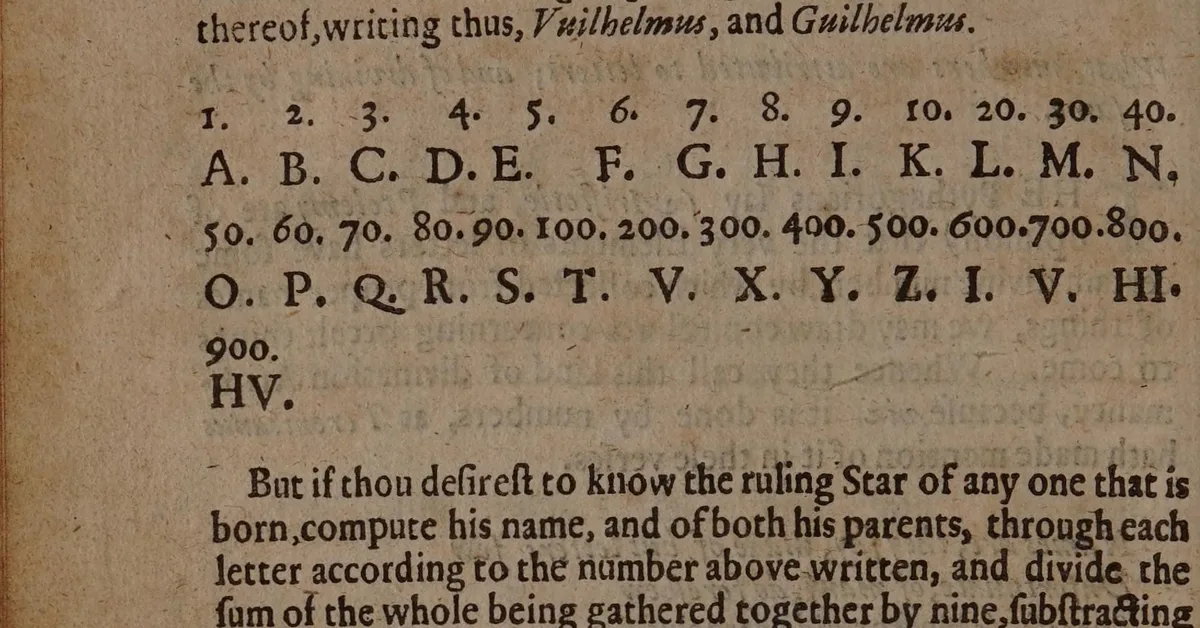
Giving letters numbers is an old habit, and a traceable one. Gematria, the practice of adding up the letter-values of a word, is attested as far back as an Assyrian inscription from the 8th century BCE, older than the Jewish tradition it’s usually credited to.1 In 1533 the German occultist Cornelius Agrippa laid number values across the Latin alphabet directly, the ancestor of the chart you used above.2 So turning a name into a sum has a long, traceable paper trail.
Reading that sum as a person’s character and calling is far younger. The person most often credited with turning number symbolism into a reading of the self is L. Dow Balliett, an American New Thought writer, whose 1905 book How to Attain Success Through the Strength of Vibration is the earliest we have found to read a name as character, and whose 1908 The Philosophy of Numbers gave each number its meaning. She read a name for “the hidden strength or weakness” it carried, and the later system built the Expression on top of that reading: the whole name as the whole person.3 The word numerology itself is younger still; its occult sense is in print by 1907.4 The numerology guide traces the dates.
Worth being clear about the seam, because most pages on this subject blur it. The arithmetic is ancient. The idea that your birth name spells out your talents is about 120 years old, and even Balliett didn’t present it as fortune-telling. She framed it as “number vibration,” a felt correspondence resting on her own metaphysics, a way of reading character rather than forecasting a life. The old counting and the modern reading are two different things, and we’d rather tell you which is which than let one borrow the other’s age.
What your number actually means
The Expression number tells you which digit your name reduces to. What that digit means is the deep part, and it’s the oldest part: the symbolism of one, of five, of nine reaches back thousands of years, long before anyone thought to read it off a name. Rather than repeat that history once for each name number, we keep it in one place. Each digit has a single meaning page that traces it from its earliest legible sense to the reading you’d recognise today.
So once you have your Expression number, follow it down to the number itself:
Keep exploring the numbers
If you haven’t done the sum yet, the Expression calculator works it out from your name and reduces it for you. The numerology guide covers how reduction works in the first place, and how the Expression sits among the other core numbers.
How to use it
An Expression number is better used as a mirror than a forecast. It won’t tell you what happens on Tuesday, and it won’t pick your career. What it’s good for is naming an aptitude you might already lean on without crediting: you hold the reading up against what actually comes easily to you, and you keep the part that rings true.
So the honest way to use it is this: do the arithmetic yourself, read the digit underneath it, and keep whatever helps you see yourself a little more clearly. The part that lands is the part worth sitting with; the rest you’re free to leave. What is it you can do without quite trying, that you’ve never thought to call a gift?
Keep reading
References
- Gematria: the Sargon II inscription (727–707 BCE) The earliest attested letter-as-number practice, Assyrian rather than Jewish; documented in the Encyclopaedia Judaica.
- Cornelius Agrippa, Three Books of Occult Philosophy Book II (1533; Freake trans., 1651) — number values mapped across the Latin alphabet.
- L. Dow Balliett, The Philosophy of Numbers: Their Tone and Colors (1908; 5th ed. 1917) — the New Thought reworking of number symbolism into character, read from a person's name.
- Etymonline: "numerology" Dates the word's occult sense "by 1911", a floor and not a first use (the earliest we have found is 1907); the practice it names is older than the name.
Cite this page
Numeluna. The Expression number, explained. Published . https://numeluna.com/expression-number/